
Textbook Question
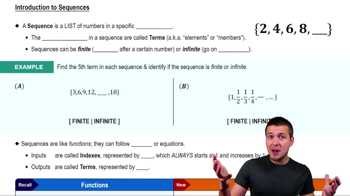
27–34. Working with sequences Several terms of a sequence {aₙ}ₙ₌₁∞ are given.
a. Find the next two terms of the sequence.
{-5, 5, -5, 5, ......}
1
views

 Verified step by step guidance
 8:22
8:22 8:22
8:22 05:03
05:0327–34. Working with sequences Several terms of a sequence {aₙ}ₙ₌₁∞ are given.
a. Find the next two terms of the sequence.
{-5, 5, -5, 5, ......}
87. Explain why or why not
Determine whether the following statements are true and give an explanation or counterexample.
a. If ∑ (k = 1 to ∞) aₖ converges, then ∑ (k = 10 to ∞) aₖ converges.
41–44. {Use of Tech} Remainders and estimates Consider the following convergent series.
a. Find an upper bound for the remainder in terms of n.
41. ∑ (k = 1 to ∞) 1 / k⁶
Loglog p-series Consider the series ∑ (k = 2 to ∞) 1 / (k(ln k)(ln ln k)ᵖ), where p is a real number.
a. For what values of p does this series converge?
Explain why or why not Determine whether the following statements are true and give an explanation or counterexample.
a. n!n! = (2n)! for all positive integers n.
{Use of Tech} Repeated square roots
Consider the sequence defined by
aₙ₊₁ = √(2 + aₙ),a₀ = √2, for n = 0, 1, 2, 3, …
a.Evaluate the first four terms of the sequence {aₙ}.
State the exact values first, and then the approximate values.