Ch. 10 - Sequences and Infinite Series
Briggs - Calculus: Early Transcendentals 3rd Edition
Briggs3rd EditionCalculus: Early TranscendentalsISBN: 9780136847243Not the one you use?Change textbook
Chapter 10, Problem 10.3.89a

88–89. Binary numbers
Humans use the ten digits 0 through 9 to form base-10 or decimal numbers, whereas computers calculate and store numbers internally as binary numbers—numbers consisting entirely of 0’s and 1’s. For this exercise, we consider binary numbers that have the form 0.b₁b₂b₃⋯, where each of the digits b₁, b₂, b₃, ⋯ is either 0 or 1. The base-10 representation of the binary number 0.b₁b₂b₃⋯ is the infinite series
b₁ / 2¹ + b₂ / 2² + b₃ / 2³ + ⋯


89. Computers can store only a finite number of digits and therefore numbers with nonterminating digits must be rounded or truncated before they can be used and stored by a computer.


a. Find the base-10 representation of the binary number 0.001̅1.

Verified step by step guidance
1
Understand that the binary number 0.001\(\overline{1}\) means the digits after the decimal point start with 0, 0, 1, followed by an infinite repeating sequence of 1's.
Express the number as the sum of two parts: the finite part 0.001 in binary, and the infinite repeating part 0.000\(\overline{1}\) starting from the fourth digit.
Convert the finite part 0.001 to base-10 by summing the values of each digit: \(b_1/2^1 + b_2/2^2 + b_3/2^3\) where \(b_1=0\), \(b_2=0\), and \(b_3=1\).
Represent the infinite repeating part as a geometric series starting at the fourth digit: \(\sum_{n=4}^\infty \frac{1}{2^n}\), since the repeating digit is 1 at every position from the fourth digit onward.
Calculate the sum of the geometric series using the formula for an infinite geometric series \(S = \frac{a}{1 - r}\), where \(a\) is the first term and \(r\) is the common ratio, then add this to the finite part to get the full base-10 representation.

Verified video answer for a similar problem:

This video solution was recommended by our tutors as helpful for the problem above.
Video duration:
3m
Was this helpful?

Key Concepts

Here are the essential concepts you must grasp in order to answer the question correctly.

Binary Number Representation

Binary numbers use only two digits, 0 and 1, to represent values. A binary number like 0.b₁b₂b₃⋯ represents a fractional value where each digit bₙ is weighted by 1 divided by 2 to the power n. Understanding this positional value system is essential to convert binary fractions into base-10 decimals.
Recommended video:
4:47
The Number e

Infinite Geometric Series

An infinite geometric series is a sum of infinitely many terms where each term is a constant ratio times the previous term. For binary fractions with repeating digits, the base-10 value can be expressed as such a series, allowing calculation of exact decimal equivalents by summing the series.
Recommended video:
06:00
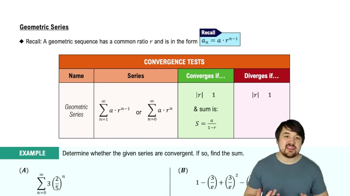
Geometric Series

Conversion of Repeating Binary Fractions to Decimal

Repeating binary fractions, like 0.001̅1, have digits that repeat infinitely. To convert them to decimal, identify the repeating block, express it as an infinite geometric series, and sum it to find the exact decimal value. This process is analogous to converting repeating decimals in base-10.
Recommended video:
11:26
Partial Fraction Decomposition: Repeated Linear Factors