Ch. 10 - Sequences and Infinite Series
Briggs - Calculus: Early Transcendentals 3rd Edition
Briggs3rd EditionCalculus: Early TranscendentalsISBN: 9780136847243Not the one you use?Change textbook
Chapter 10, Problem 10.R.23

12–24. Limits of sequences Evaluate the limit of the sequence or state that it does not exist.
aₙ = (–1)ⁿ / 0.9ⁿ

Verified step by step guidance
1
Identify the general term of the sequence: \(a_n = \frac{(-1)^n}{0.9^n}\).
Rewrite the denominator to understand its behavior as \(n\) increases: since \(0.9^n = (\frac{9}{10})^n\), it is a positive number less than 1 raised to the power \(n\).
Recall that when a number between 0 and 1 is raised to larger and larger powers, it approaches 0, so \(0.9^n \to 0\) as \(n \to \infty\).
Consider the numerator \((-1)^n\), which oscillates between \(+1\) and \(-1\) depending on whether \(n\) is even or odd.
Combine these observations: since the denominator approaches 0 and the numerator oscillates between \(+1\) and \(-1\), analyze the behavior of the fraction \(\frac{(-1)^n}{0.9^n}\) as \(n\) grows large to determine if the limit exists or diverges.

Verified video answer for a similar problem:

This video solution was recommended by our tutors as helpful for the problem above.
Video duration:
3m
Was this helpful?

Key Concepts

Here are the essential concepts you must grasp in order to answer the question correctly.

Limit of a Sequence

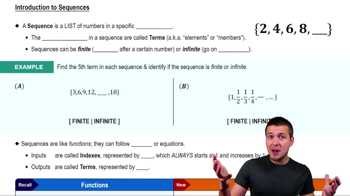
The limit of a sequence is the value that the terms of the sequence approach as the index n goes to infinity. If the terms get arbitrarily close to a specific number, the sequence converges to that limit; otherwise, it diverges.
Recommended video:
Guided course
8:22
Introduction to Sequences

Behavior of Exponential Functions

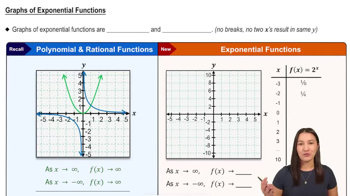
Exponential functions with bases greater than 1 grow without bound, while those with bases between 0 and 1 approach zero as n increases. Understanding this helps determine the dominant behavior of terms like 0.9ⁿ in sequences.
Recommended video:
5:46
Graphs of Exponential Functions

Alternating Sequences

An alternating sequence changes sign with each term, often expressed as (–1)ⁿ or (–1)ⁿ⁺¹. Such sequences may oscillate and not have a limit unless the magnitude of terms approaches zero.
Recommended video:
Guided course
8:22
Introduction to Sequences