
Ch. 10 - Sequences and Infinite Series
Briggs - Calculus: Early Transcendentals 3rd Edition
Briggs3rd EditionCalculus: Early TranscendentalsISBN: 9780136847243Not the one you use?Change textbook
Chapter 10, Problem 10.1.73a

72–75. {Use of Tech} Practical sequences
Consider the following situations that generate a sequence


a.Write out the first five terms of the sequence.


Radioactive decay
A material transmutes 50% of its mass to another element every 10 years due to radioactive decay. Let Mₙ be the mass of the radioactive material at the end of the nᵗʰ decade, where the initial mass of the material is M₀ = 20g.

Verified step by step guidance
1
Identify the type of sequence described. Since the material loses 50% of its mass every 10 years, this is a geometric sequence where each term is multiplied by a common ratio.
Determine the common ratio \( r \). Because the material retains 50% of its mass each decade, \( r = 0.5 \).
Write the general formula for the \( n^{th} \) term of the sequence: \( M_n = M_0 \times r^n \), where \( M_0 = 20 \) grams is the initial mass.
Calculate the first five terms by substituting \( n = 0, 1, 2, 3, 4 \) into the formula: \( M_0, M_1, M_2, M_3, M_4 \).
Express each term explicitly as \( M_n = 20 \times (0.5)^n \) grams, and write out the values for \( n = 0 \) through \( n = 4 \) without simplifying the numerical results.

Verified video answer for a similar problem:

This video solution was recommended by our tutors as helpful for the problem above.
Video duration:
1m
Was this helpful?

Key Concepts

Here are the essential concepts you must grasp in order to answer the question correctly.

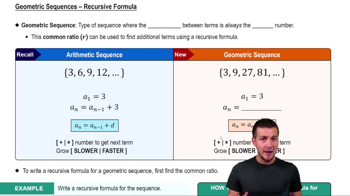
Geometric Sequences

A geometric sequence is a sequence where each term is found by multiplying the previous term by a constant ratio. In this problem, the mass decreases by 50% every 10 years, so the ratio is 0.5. Understanding geometric sequences helps to write out terms like M₁ = M₀ × 0.5, M₂ = M₁ × 0.5, and so on.
Recommended video:
Guided course
04:18
Geometric Sequences - Recursive Formula

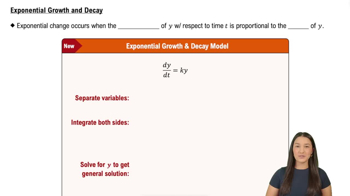
Exponential Decay

Exponential decay describes processes where quantities decrease at a rate proportional to their current value. Radioactive decay is a classic example, where the mass reduces by a fixed percentage over equal time intervals. This concept explains why the mass halves every decade, leading to a geometric sequence.
Recommended video:
09:29
Exponential Growth & Decay

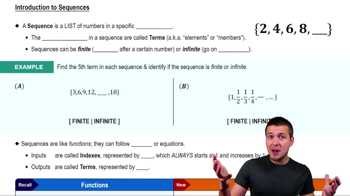
Sequence Notation and Indexing

Sequence notation uses subscripts to denote terms, such as Mₙ for the nth term. Indexing helps track the progression of the sequence over discrete steps—in this case, decades. Correctly interpreting M₀ as the initial mass and Mₙ as the mass after n decades is essential for writing and understanding the terms.
Recommended video:
Guided course
8:22
Introduction to Sequences
Related Practice
Textbook Question

{Use of Tech} A savings plan

James begins a savings plan in which he deposits \(100 at the beginning of each month into an account that earns 9% interest annually, or equivalently, 0.75% per month.

To be clear, on the first day of each month, the bank adds 0.75% of the current balance as interest, and then James deposits \)100.


Let Bₙ be the balance in the account after the nᵗʰ payment, where B₀ = \$0.


a.Write the first five terms of the sequence {Bₙ}.

1
views
Textbook Question

27–34. Working with sequences Several terms of a sequence {aₙ}ₙ₌₁∞ are given.

b. Find a recurrence relation that generates the sequence (supply the initial value of the index and the first term of the sequence).


{1, 3, 9, 27, 81, ......}

2
views
Textbook Question

Explain why or why not Determine whether the following statements are true and give an explanation or counterexample.


a. The sum ∑ (k = 1 to ∞) 1 / 3ᵏ is a p-series.

Textbook Question

{Use of Tech} Drug Dosing

A patient takes 75 mg of a medication every 12 hours; 60% of the medication in the blood is eliminated every 12 hours.


a.Let dₙ equal the amount of medication (in mg) in the bloodstream after n doses, where d₁ = 75.

Find a recurrence relation for dₙ.

2
views
Textbook Question

27–34. Working with sequences Several terms of a sequence {aₙ}ₙ₌₁∞ are given.

a. Find the next two terms of the sequence.

{1, 2, 4, 8, 16, ......}

1
views
Textbook Question

Explain why or why not Determine whether the following statements are true and give an explanation or counterexample.


a. A series that converges must converge absolutely.