
Ch. 10 - Sequences and Infinite Series
Briggs - Calculus: Early Transcendentals 3rd Edition
Briggs3rd EditionCalculus: Early TranscendentalsISBN: 9780136847243Not the one you use?Change textbook
Chapter 10, Problem 10.1.29a

27–34. Working with sequences Several terms of a sequence {aₙ}ₙ₌₁∞ are given.
a. Find the next two terms of the sequence.
{1, 2, 4, 8, 16, ......}

Verified step by step guidance
1
Identify the pattern in the given sequence: {1, 2, 4, 8, 16, ......}. Notice how each term relates to the previous term.
Check if the sequence is geometric by dividing each term by the previous term. For example, calculate \( \frac{2}{1} \), \( \frac{4}{2} \), \( \frac{8}{4} \), and \( \frac{16}{8} \).
If the ratio between consecutive terms is constant, denote this common ratio as \( r \). This means the sequence is geometric and each term can be expressed as \( a_n = a_1 \times r^{n-1} \).
Use the formula for the \( n \)-th term of a geometric sequence to find the next terms. Substitute \( n = 6 \) and \( n = 7 \) into \( a_n = a_1 \times r^{n-1} \) to find the 6th and 7th terms.
Write down the next two terms based on the calculations from the previous step, completing the sequence.

Verified video answer for a similar problem:

This video solution was recommended by our tutors as helpful for the problem above.
Video duration:
1m
Was this helpful?

Key Concepts

Here are the essential concepts you must grasp in order to answer the question correctly.

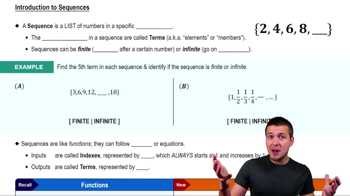
Definition of a Sequence

A sequence is an ordered list of numbers following a specific pattern or rule. Each number in the sequence is called a term, typically denoted as aₙ, where n indicates the term's position. Understanding the pattern helps predict subsequent terms.
Recommended video:
Guided course
8:22
Introduction to Sequences

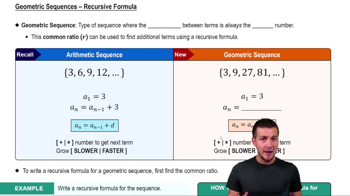
Geometric Sequences

A geometric sequence is one where each term is found by multiplying the previous term by a constant called the common ratio. For example, in the sequence {1, 2, 4, 8, 16, ...}, the common ratio is 2, meaning each term doubles the previous one.
Recommended video:
Guided course
04:18
Geometric Sequences - Recursive Formula

Finding Next Terms in a Sequence

To find the next terms, identify the pattern or rule governing the sequence. For geometric sequences, multiply the last known term by the common ratio. This method allows extending the sequence logically and accurately.
Recommended video:
Guided course
8:22
Introduction to Sequences
Related Practice
Textbook Question

27–34. Working with sequences Several terms of a sequence {aₙ}ₙ₌₁∞ are given.

b. Find a recurrence relation that generates the sequence (supply the initial value of the index and the first term of the sequence).


{1, 3, 9, 27, 81, ......}

2
views
Textbook Question

{Use of Tech} Periodic dosing

Many people take aspirin on a regular basis as a preventive measure for heart disease. Suppose a person takes 80 mg of aspirin every 24 hours. Assume aspirin has a half-life of 24 hours; that is, every 24 hours, half of the drug in the blood is eliminated.


b.Use a calculator to estimate this limit. In the long run, how much drug is in the person’s blood?

1
views
Textbook Question

Explain why or why not Determine whether the following statements are true and give an explanation or counterexample.


a. The sum ∑ (k = 1 to ∞) 1 / 3ᵏ is a p-series.

Textbook Question

{Use of Tech} Drug Dosing

A patient takes 75 mg of a medication every 12 hours; 60% of the medication in the blood is eliminated every 12 hours.


a.Let dₙ equal the amount of medication (in mg) in the bloodstream after n doses, where d₁ = 75.

Find a recurrence relation for dₙ.

2
views
Textbook Question

Explain why or why not Determine whether the following statements are true and give an explanation or counterexample.


a. A series that converges must converge absolutely.

Textbook Question

72–75. {Use of Tech} Practical sequences

Consider the following situations that generate a sequence


a.Write out the first five terms of the sequence.


Radioactive decay

A material transmutes 50% of its mass to another element every 10 years due to radioactive decay. Let Mₙ be the mass of the radioactive material at the end of the nᵗʰ decade, where the initial mass of the material is M₀ = 20g.

1
views