
Ch. 10 - Sequences and Infinite Series
Briggs - Calculus: Early Transcendentals 3rd Edition
Briggs3rd EditionCalculus: Early TranscendentalsISBN: 9780136847243Not the one you use?Change textbook
Chapter 10, Problem 10.6.65a

Explain why or why not Determine whether the following statements are true and give an explanation or counterexample.


a. A series that converges must converge absolutely.

Verified step by step guidance
1
Recall the definitions: A series \( \sum a_n \) converges absolutely if \( \sum |a_n| \) converges, and it converges conditionally if \( \sum a_n \) converges but \( \sum |a_n| \) diverges.
Understand that absolute convergence implies convergence, but the converse is not necessarily true.
Consider the alternating harmonic series \( \sum (-1)^{n+1} \frac{1}{n} \), which converges by the Alternating Series Test but does not converge absolutely because \( \sum \frac{1}{n} \) diverges.
This example shows that a series can converge without converging absolutely, so the statement 'A series that converges must converge absolutely' is false.
Therefore, the correct conclusion is that convergence does not imply absolute convergence; some series converge conditionally.

Verified video answer for a similar problem:

This video solution was recommended by our tutors as helpful for the problem above.
Video duration:
1m
Was this helpful?

Key Concepts

Here are the essential concepts you must grasp in order to answer the question correctly.

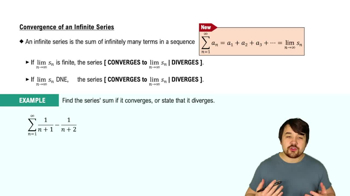
Convergence of a Series

A series converges if the sequence of its partial sums approaches a finite limit. This means the sum of infinitely many terms settles to a specific value, indicating the series has a well-defined total.
Recommended video:
06:52
Convergence of an Infinite Series

Absolute Convergence

A series converges absolutely if the series formed by taking the absolute values of its terms also converges. Absolute convergence guarantees convergence and often simplifies analysis, especially for series with both positive and negative terms.
Recommended video:
07:51
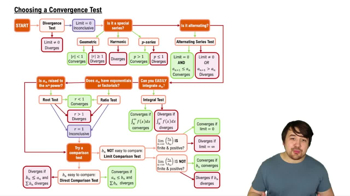
Choosing a Convergence Test

Conditional Convergence and Counterexamples

A series is conditionally convergent if it converges but does not converge absolutely. The alternating harmonic series is a classic example, showing that convergence does not imply absolute convergence, which is crucial for evaluating the truth of the statement.
Recommended video:
07:51
Choosing a Convergence Test
Related Practice
Textbook Question

{Use of Tech} A savings plan

James begins a savings plan in which he deposits \(100 at the beginning of each month into an account that earns 9% interest annually, or equivalently, 0.75% per month.

To be clear, on the first day of each month, the bank adds 0.75% of the current balance as interest, and then James deposits \)100.


Let Bₙ be the balance in the account after the nᵗʰ payment, where B₀ = \$0.


a.Write the first five terms of the sequence {Bₙ}.

1
views
Textbook Question

Explain why or why not Determine whether the following statements are true and give an explanation or counterexample.


a. The sum ∑ (k = 1 to ∞) 1 / 3ᵏ is a p-series.

Textbook Question

27–34. Working with sequences Several terms of a sequence {aₙ}ₙ₌₁∞ are given.

a. Find the next two terms of the sequence.

{1, 2, 4, 8, 16, ......}

1
views
Textbook Question

27–34. Working with sequences Several terms of a sequence {aₙ}ₙ₌₁∞ are given.

a. Find the next two terms of the sequence.


{1, 3, 9, 27, 81, ......}

1
views
Textbook Question

Explain why or why not

Determine whether the following statements are true and give an explanation or counterexample.


a.The sequence of partial sums for the series1 + 2 + 3 + ⋯ is {1, 3, 6, 10, …}.

Textbook Question

72–75. {Use of Tech} Practical sequences

Consider the following situations that generate a sequence


a.Write out the first five terms of the sequence.


Radioactive decay

A material transmutes 50% of its mass to another element every 10 years due to radioactive decay. Let Mₙ be the mass of the radioactive material at the end of the nᵗʰ decade, where the initial mass of the material is M₀ = 20g.

1
views