
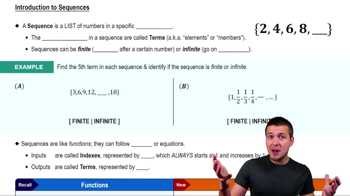
27–34. Working with sequences Several terms of a sequence {aₙ}ₙ₌₁∞ are given.
b. Find a recurrence relation that generates the sequence (supply the initial value of the index and the first term of the sequence).
{1, 3, 9, 27, 81, ......}
Verified step by step guidance
27–34. Working with sequences Several terms of a sequence {aₙ}ₙ₌₁∞ are given.
b. Find a recurrence relation that generates the sequence (supply the initial value of the index and the first term of the sequence).
{1, 3, 9, 27, 81, ......}
{Use of Tech} Periodic dosing
Many people take aspirin on a regular basis as a preventive measure for heart disease. Suppose a person takes 80 mg of aspirin every 24 hours. Assume aspirin has a half-life of 24 hours; that is, every 24 hours, half of the drug in the blood is eliminated.
b.Use a calculator to estimate this limit. In the long run, how much drug is in the person’s blood?
Explain why or why not Determine whether the following statements are true and give an explanation or counterexample.
a. The sum ∑ (k = 1 to ∞) 1 / 3ᵏ is a p-series.
27–34. Working with sequences Several terms of a sequence {aₙ}ₙ₌₁∞ are given.
a. Find the next two terms of the sequence.
{1, 2, 4, 8, 16, ......}
72–75. {Use of Tech} Practical sequences
Consider the following situations that generate a sequence
a.Write out the first five terms of the sequence.
Radioactive decay
A material transmutes 50% of its mass to another element every 10 years due to radioactive decay. Let Mₙ be the mass of the radioactive material at the end of the nᵗʰ decade, where the initial mass of the material is M₀ = 20g.
{Use of Tech} Fibonacci sequence
The famous Fibonacci sequence was proposed by Leonardo Pisano, also known as Fibonacci, in about A.D. 1200 as a model for the growth of rabbit populations.
It is given by the recurrence relation: fₙ₊₁ = fₙ + fₙ₋₁,for n = 1, 2, 3, … where f₀ = 1 and f₁ = 1. Each term of the sequence is the sum of its two predecessors.
b.Is the sequence bounded?