What comparison series would you use with the Comparison Test to determine whether ∑ (k = 1 to ∞) 2ᵏ / (3ᵏ + 1) converges?

Ch. 10 - Sequences and Infinite Series
Briggs3rd EditionCalculus: Early TranscendentalsISBN: 9780136847243Not the one you use?Change textbook
Chapter 10, Problem 10.4.85
11–86. Applying convergence tests Determine whether the following series converge. Justify your answers.
1 / (2·3) + 1 / (4·5) + 1 / (6·7) + 1 / (8·9) + ⋯
Verified step by step guidance1
Identify the general term of the series. Notice the pattern in the denominators: the first term is \( \frac{1}{2 \cdot 3} \), the second is \( \frac{1}{4 \cdot 5} \), the third is \( \frac{1}{6 \cdot 7} \), and so on. We can express the \(n\)-th term as \( a_n = \frac{1}{(2n)(2n+1)} \).
Simplify the general term using partial fraction decomposition. Write \( \frac{1}{(2n)(2n+1)} \) as \( \frac{A}{2n} + \frac{B}{2n+1} \) and solve for constants \(A\) and \(B\). This will help in understanding the behavior of the series.
After finding the partial fractions, rewrite the series as a telescoping series if possible. Telescoping series have terms that cancel out sequentially, making it easier to analyze convergence.
Evaluate the partial sums of the series using the telescoping form. Write the sum of the first \(N\) terms and simplify to see if the sum approaches a finite limit as \(N \to \infty\).
Conclude about the convergence of the series based on the behavior of the partial sums. If the partial sums approach a finite number, the series converges; otherwise, it diverges.

Verified video answer for a similar problem:
This video solution was recommended by our tutors as helpful for the problem above.
Video duration:
5mKey Concepts
Here are the essential concepts you must grasp in order to answer the question correctly.
Convergence of Infinite Series
An infinite series converges if the sum of its terms approaches a finite limit as the number of terms increases indefinitely. Understanding convergence is essential to determine whether adding infinitely many terms results in a finite value or diverges to infinity.
Recommended video:
Guided course
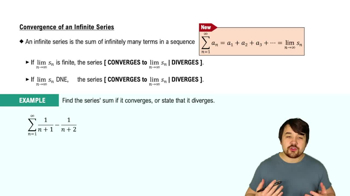
Convergence of an Infinite Series
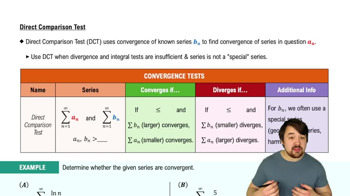
Comparison Test
The Comparison Test involves comparing the given series to a known benchmark series with established convergence behavior. If the terms of the given series are smaller than those of a convergent series, it also converges; if larger than a divergent series, it diverges.
Recommended video:
Guided course
Direct Comparison Test
General Term Analysis and Simplification
Expressing the general term of the series in a simplified form helps identify its behavior and apply convergence tests effectively. For example, rewriting terms like 1/(2n(2n+1)) can reveal similarities to p-series or telescoping series.
Recommended video:
Guided course
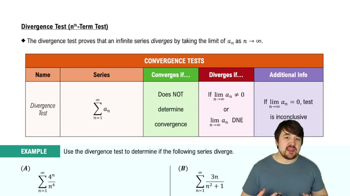
Divergence Test (nth Term Test)
Related Practice
Textbook Question
Textbook Question
40–62. Choose your test Use the test of your choice to determine whether the following series converge.
∑ (k = 1 to ∞) k⁸ / (k¹¹ + 3)
Textbook Question
21–42. Geometric series Evaluate each geometric series or state that it diverges.
37.1 + e/π + e²/π² + e³/π³ + ⋯
1
views
Textbook Question
32–49. Choose your test Use the test of your choice to determine whether the following series converge absolutely, converge conditionally, or diverge.
∑ (from k = 1 to ∞) (2k + 1)! / (k!)²
Textbook Question
46–53. Decimal expansions
Write each repeating decimal first as a geometric series and then as a fraction (a ratio of two integers).
47.0.3̅ = 0.333…
1
views
Textbook Question
40–62. Choose your test Use the test of your choice to determine whether the following series converge.
∑ (k = 3 to ∞) 1 / lnk