
Textbook Question
11–86. Applying convergence tests Determine whether the following series converge. Justify your answers.
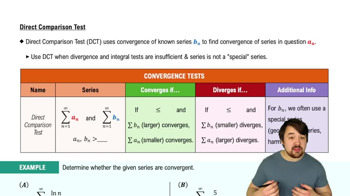
1 / (2·3) + 1 / (4·5) + 1 / (6·7) + 1 / (8·9) + ⋯

 Verified step by step guidance
 09:25
09:25
 06:00
06:00 5:50
5:5011–86. Applying convergence tests Determine whether the following series converge. Justify your answers.
1 / (2·3) + 1 / (4·5) + 1 / (6·7) + 1 / (8·9) + ⋯
21–42. Geometric series Evaluate each geometric series or state that it diverges.
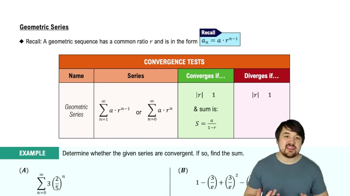
37.1 + e/π + e²/π² + e³/π³ + ⋯
32–49. Choose your test Use the test of your choice to determine whether the following series converge absolutely, converge conditionally, or diverge.
∑ (from k = 1 to ∞) (2k + 1)! / (k!)²
46–53. Decimal expansions
Write each repeating decimal first as a geometric series and then as a fraction (a ratio of two integers).
47.0.3̅ = 0.333…
40–62. Choose your test Use the test of your choice to determine whether the following series converge.
∑ (k = 3 to ∞) 1 / lnk
23–38. Divergence, Integral, and p-series Tests Use the Divergence Test, the Integral Test, or the p-series test to determine whether the following series converge.
∑ (k = 1 to ∞) k^(1/k)