What comparison series would you use with the Comparison Test to determine whether ∑ (k = 1 to ∞) 2ᵏ / (3ᵏ + 1) converges?
Ch. 10 - Sequences and Infinite Series
Briggs3rd EditionCalculus: Early TranscendentalsISBN: 9780136847243Not the one you use?Change textbook
Chapter 10, Problem 10.1.15
13–20. Explicit formulas Write the first four terms of the sequence { aₙ }∞ₙ₌₁.
aₙ = (−1)ⁿ / 2ⁿ
Verified step by step guidance1
Identify the general term of the sequence given by the formula \(a_n = \frac{(-1)^n}{2^n}\), where \(n\) is the term number starting from 1.
Calculate the first term \(a_1\) by substituting \(n=1\) into the formula: \(a_1 = \frac{(-1)^1}{2^1}\).
Calculate the second term \(a_2\) by substituting \(n=2\) into the formula: \(a_2 = \frac{(-1)^2}{2^2}\).
Calculate the third term \(a_3\) by substituting \(n=3\) into the formula: \(a_3 = \frac{(-1)^3}{2^3}\).
Calculate the fourth term \(a_4\) by substituting \(n=4\) into the formula: \(a_4 = \frac{(-1)^4}{2^4}\).

Verified video answer for a similar problem:
This video solution was recommended by our tutors as helpful for the problem above.
Video duration:
2mWas this helpful?
Key Concepts
Here are the essential concepts you must grasp in order to answer the question correctly.
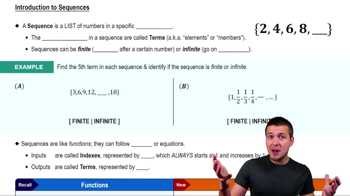
Sequences and Terms
A sequence is an ordered list of numbers defined by a specific rule or formula. Each number in the sequence is called a term, denoted as aₙ, where n indicates the term's position. Understanding how to find terms from the explicit formula is essential for writing out the sequence.
Recommended video:
Guided course
Introduction to Sequences
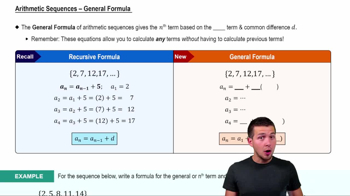
Explicit Formula for Sequences
An explicit formula directly defines the nth term of a sequence as a function of n, allowing calculation of any term without knowing previous terms. For example, aₙ = (-1)ⁿ / 2ⁿ gives a direct way to compute each term by substituting n.
Recommended video:
Guided course
Arithmetic Sequences - General Formula
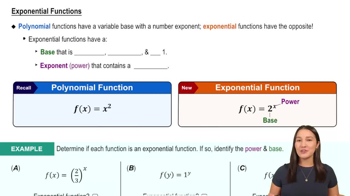
Exponentiation and Alternating Signs
Exponentiation involves raising a base to a power, such as 2ⁿ. The term (-1)ⁿ introduces alternating signs because (-1) raised to an even power is positive, and to an odd power is negative. This pattern affects the sign of each term in the sequence.
Recommended video:
Exponential Functions
Related Practice
Textbook Question
Textbook Question
72–86. Evaluating series Evaluate each series or state that it diverges.
∑ (k = 1 to ∞) (((1/6)ᵏ + (1/3)ᵏ) × k⁻¹)
Textbook Question
40–62. Choose your test Use the test of your choice to determine whether the following series converge.
∑ (k = 1 to ∞) k⁸ / (k¹¹ + 3)
Textbook Question
11–86. Applying convergence tests Determine whether the following series converge. Justify your answers.
1 / (2·3) + 1 / (4·5) + 1 / (6·7) + 1 / (8·9) + ⋯
Textbook Question
21–42. Geometric series Evaluate each geometric series or state that it diverges.
37.1 + e/π + e²/π² + e³/π³ + ⋯
1
views
Textbook Question
46–53. Decimal expansions
Write each repeating decimal first as a geometric series and then as a fraction (a ratio of two integers).
47.0.3̅ = 0.333…
1
views