Ch. 10 - Sequences and Infinite Series
Briggs - Calculus: Early Transcendentals 3rd Edition
Briggs3rd EditionCalculus: Early TranscendentalsISBN: 9780136847243Not the one you use?Change textbook
Chapter 10, Problem 10.3.7

Find a formula for the nth partial sum Sₙ of
∑ k = 1 to ∞[(1/(k + 3)) − (1/(k + 4))]
Use your formula to find the sum of the first 36 terms of the series.

Verified step by step guidance
1
Recognize that the series is a telescoping series of the form \( \sum_{k=1}^\infty \left( \frac{1}{k+3} - \frac{1}{k+4} \right) \). This means many terms will cancel out when we write out the partial sums explicitly.
Write the nth partial sum \( S_n \) as \( S_n = \sum_{k=1}^n \left( \frac{1}{k+3} - \frac{1}{k+4} \right) \).
Expand the sum to see the cancellation pattern: \( S_n = \left( \frac{1}{4} - \frac{1}{5} \right) + \left( \frac{1}{5} - \frac{1}{6} \right) + \cdots + \left( \frac{1}{n+3} - \frac{1}{n+4} \right) \). Notice that most intermediate terms cancel out.
After cancellation, the partial sum simplifies to \( S_n = \frac{1}{4} - \frac{1}{n+4} \). This is the formula for the nth partial sum.
To find the sum of the first 36 terms, substitute \( n = 36 \) into the formula: \( S_{36} = \frac{1}{4} - \frac{1}{36+4} \). You can then simplify this expression to get the numerical value.

Verified video answer for a similar problem:

This video solution was recommended by our tutors as helpful for the problem above.
Video duration:
3m
Was this helpful?

Key Concepts

Here are the essential concepts you must grasp in order to answer the question correctly.

Telescoping Series

A telescoping series is a series where many terms cancel out when the partial sums are expanded, leaving only a few terms from the beginning and end. This simplification makes it easier to find a formula for the nth partial sum by identifying the pattern of cancellation.
Recommended video:
06:00
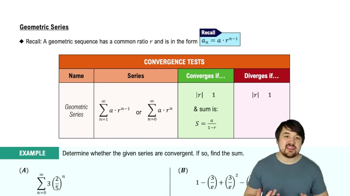
Geometric Series

Partial Sums

The nth partial sum, Sₙ, is the sum of the first n terms of a series. Finding a formula for Sₙ helps analyze the behavior of the series and compute sums for specific values of n without adding each term individually.
Recommended video:
08:01
Integration Using Partial Fractions

Evaluating Finite Sums

Once a formula for the nth partial sum is found, it can be used to calculate the sum of a finite number of terms by substituting the desired n value. This process avoids direct summation and leverages the simplified expression derived from the telescoping property.
Recommended video:
05:44
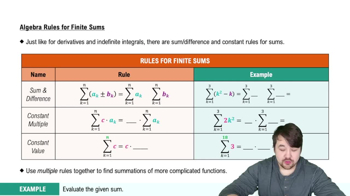
Algebra Rules for Finite Sums
Related Practice
Textbook Question

9–36. Comparison tests Use the Comparison Test or the Limit Comparison Test to determine whether the following series converge.


∑ (k = 1 to ∞) ((3k³ + 4)(7k² + 1)) / ((2k³ + 1)(4k³ − 1))

Textbook Question

16–17. {Use of Tech} Periodic savings

Suppose you deposit m dollars at the beginning of every month in a savings account that earns a monthly interest rate of r, which is the annual interest rate divided by 12 (for example, if the annual interest rate is 2.4%, r = 0.024/12 = 0.002). For an initial investment of m dollars, the amount of money in your account at the beginning of the second month is the sum of your second deposit and your initial deposit plus interest, or m + m(1 + r). Continuing in this fashion, it can be shown that the amount of money in your account after n months is


Aₙ = m + m(1 + r) + ⋯ + m(1 + r)ⁿ⁻¹.


Use geometric sums to determine the amount of money in your savings account after 5 years (60 months) using the given monthly deposit and interest rate.


17. Monthly deposits of \$250 at a monthly interest rate of 0.2%

1
views
Textbook Question

13–20. Explicit formulas Write the first four terms of the sequence { aₙ }∞ₙ₌₁. 

aₙ = 1 + sin(πn / 2)

Textbook Question

72–86. Evaluating series Evaluate each series or state that it diverges.

∑ (k = 1 to ∞) (((1/6)ᵏ + (1/3)ᵏ) × k⁻¹)

Textbook Question

40–62. Choose your test Use the test of your choice to determine whether the following series converge.

∑ (k = 1 to ∞) k⁸ / (k¹¹ + 3)

Textbook Question

11–86. Applying convergence tests Determine whether the following series converge. Justify your answers.

1 / (2·3) + 1 / (4·5) + 1 / (6·7) + 1 / (8·9) + ⋯