
Textbook Question
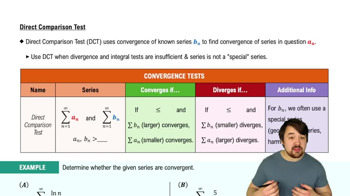
32–49. Choose your test Use the test of your choice to determine whether the following series converge absolutely, converge conditionally, or diverge.
∑ (from k = 1 to ∞) k¹⁰⁰ / (k + 1)!

 Verified step by step guidance
 09:25
09:25
 07:45
07:45 5:50
5:5032–49. Choose your test Use the test of your choice to determine whether the following series converge absolutely, converge conditionally, or diverge.
∑ (from k = 1 to ∞) k¹⁰⁰ / (k + 1)!
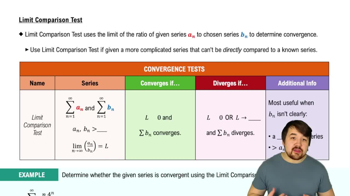
9–36. Comparison tests Use the Comparison Test or the Limit Comparison Test to determine whether the following series converge.
∑ (k = 1 to ∞) (2 + (−1)ᵏ) / k²
16–17. {Use of Tech} Periodic savings
Suppose you deposit m dollars at the beginning of every month in a savings account that earns a monthly interest rate of r, which is the annual interest rate divided by 12 (for example, if the annual interest rate is 2.4%, r = 0.024/12 = 0.002). For an initial investment of m dollars, the amount of money in your account at the beginning of the second month is the sum of your second deposit and your initial deposit plus interest, or m + m(1 + r). Continuing in this fashion, it can be shown that the amount of money in your account after n months is
Aₙ = m + m(1 + r) + ⋯ + m(1 + r)ⁿ⁻¹.
Use geometric sums to determine the amount of money in your savings account after 5 years (60 months) using the given monthly deposit and interest rate.
17. Monthly deposits of \$250 at a monthly interest rate of 0.2%
13–20. Explicit formulas Write the first four terms of the sequence { aₙ }∞ₙ₌₁.
aₙ = 1 + sin(πn / 2)
Find a formula for the nth partial sum Sₙ of
∑ k = 1 to ∞[(1/(k + 3)) − (1/(k + 4))]
Use your formula to find the sum of the first 36 terms of the series.
72–86. Evaluating series Evaluate each series or state that it diverges.
∑ (k = 1 to ∞) (((1/6)ᵏ + (1/3)ᵏ) × k⁻¹)