Ch. 10 - Sequences and Infinite Series
Briggs - Calculus: Early Transcendentals 3rd Edition
Briggs3rd EditionCalculus: Early TranscendentalsISBN: 9780136847243Not the one you use?Change textbook
Chapter 10, Problem 10.5.27

9–36. Comparison tests Use the Comparison Test or the Limit Comparison Test to determine whether the following series converge.


∑ (k = 1 to ∞) (2 + (−1)ᵏ) / k²

Verified step by step guidance
1
Identify the given series: \( \sum_{k=1}^{\infty} \frac{2 + (-1)^k}{k^2} \). Notice that the numerator alternates between \(2 + 1 = 3\) when \(k\) is even and \(2 - 1 = 1\) when \(k\) is odd.
To apply the Comparison Test or Limit Comparison Test, find a simpler series to compare with. Since \(2 + (-1)^k\) oscillates between 1 and 3, the terms of the series are bounded between \(\frac{1}{k^2}\) and \(\frac{3}{k^2}\).
Recall that the series \( \sum_{k=1}^{\infty} \frac{1}{k^2} \) is a p-series with \(p=2 > 1\), which converges.
Use the Comparison Test: since \( \frac{2 + (-1)^k}{k^2} \leq \frac{3}{k^2} \) and \( \sum \frac{3}{k^2} \) converges, the given series is bounded above by a convergent series.
Conclude that by the Comparison Test, the original series \( \sum_{k=1}^{\infty} \frac{2 + (-1)^k}{k^2} \) converges.

Verified video answer for a similar problem:

This video solution was recommended by our tutors as helpful for the problem above.
Video duration:
5m
Was this helpful?

Key Concepts

Here are the essential concepts you must grasp in order to answer the question correctly.

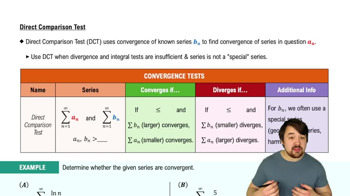
Comparison Test

The Comparison Test determines the convergence of a series by comparing it to another series with known behavior. If a series with positive terms is less than or equal to a convergent series, it also converges. Conversely, if it is greater than or equal to a divergent series, it diverges.
Recommended video:
09:25
Direct Comparison Test

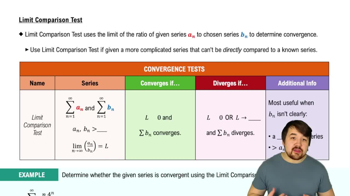
Limit Comparison Test

The Limit Comparison Test compares two series by taking the limit of the ratio of their terms. If the limit is a positive finite number, both series either converge or diverge together. This test is useful when direct comparison is difficult but the terms behave similarly for large indices.
Recommended video:
07:45
Limit Comparison Test

Behavior of Alternating Terms in Series

Series with terms involving alternating signs, such as (−1)^k, require careful analysis. The presence of alternating terms affects convergence tests, and sometimes the absolute convergence or conditional convergence must be considered. Understanding how these terms influence the series is key to applying comparison tests correctly.
Recommended video:
06:00
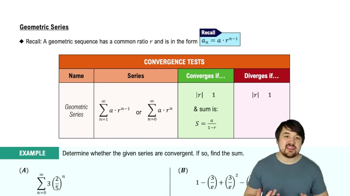
Geometric Series
Related Practice
Textbook Question

9–36. Comparison tests Use the Comparison Test or the Limit Comparison Test to determine whether the following series converge.


∑ (k = 1 to ∞) ((3k³ + 4)(7k² + 1)) / ((2k³ + 1)(4k³ − 1))

Textbook Question

21–42. Geometric series Evaluate each geometric series or state that it diverges.  


29.∑ (k = 1 to ∞) e^(–2k)

1
views
Textbook Question

9–16. Divergence Test Use the Divergence Test to determine whether the following series diverge or state that the test is inconclusive.

∑ (k = 0 to ∞) 1 / (1000 + k)

1
views
Textbook Question

32–49. Choose your test Use the test of your choice to determine whether the following series converge absolutely, converge conditionally, or diverge.

∑ (from k = 1 to ∞) k¹⁰⁰ / (k + 1)!

Textbook Question

16–17. {Use of Tech} Periodic savings

Suppose you deposit m dollars at the beginning of every month in a savings account that earns a monthly interest rate of r, which is the annual interest rate divided by 12 (for example, if the annual interest rate is 2.4%, r = 0.024/12 = 0.002). For an initial investment of m dollars, the amount of money in your account at the beginning of the second month is the sum of your second deposit and your initial deposit plus interest, or m + m(1 + r). Continuing in this fashion, it can be shown that the amount of money in your account after n months is


Aₙ = m + m(1 + r) + ⋯ + m(1 + r)ⁿ⁻¹.


Use geometric sums to determine the amount of money in your savings account after 5 years (60 months) using the given monthly deposit and interest rate.


17. Monthly deposits of \$250 at a monthly interest rate of 0.2%

1
views
Textbook Question

13–20. Explicit formulas Write the first four terms of the sequence { aₙ }∞ₙ₌₁. 

aₙ = 1 + sin(πn / 2)