Ch. 7 - Transcendental Functions
Hass - Thomas' Calculus 15th Edition
Hass15th EditionThomas' CalculusISBN: 9780137616077Not the one you use?Change textbook
Chapter 7, Problem 7.3.133

133. Find the absolute maximum value of
f(x) = x^2 * ln(1/x)
and say where it is assumed.

Verified step by step guidance
1
Rewrite the function to a more convenient form: \(f(x) = x^2 \ln\left(\frac{1}{x}\right) = x^2 (-\ln x) = -x^2 \ln x\) for \(x > 0\) since \(\ln\left(\frac{1}{x}\right)\) is defined only for positive \(x\).
Find the first derivative \(f'(x)\) using the product rule. Let \(u = -x^2\) and \(v = \ln x\), then \(f(x) = u v\). Compute \(f'(x) = u' v + u v'\) where \(u' = -2x\) and \(v' = \frac{1}{x}\).
Set the derivative equal to zero to find critical points: \(f'(x) = 0\). Solve the resulting equation for \(x\) to find candidates for local maxima or minima.
Evaluate the function \(f(x)\) at the critical points found and also consider the behavior of \(f(x)\) as \(x\) approaches the boundaries of the domain (i.e., as \(x \to 0^+\) and as \(x \to \infty\)) to determine the absolute maximum.
Compare the values of \(f(x)\) at the critical points and the limits to identify the absolute maximum value and the point where it is assumed.

Verified video answer for a similar problem:

This video solution was recommended by our tutors as helpful for the problem above.
Video duration:
9m
Was this helpful?

Key Concepts

Here are the essential concepts you must grasp in order to answer the question correctly.

Domain and Behavior of the Function

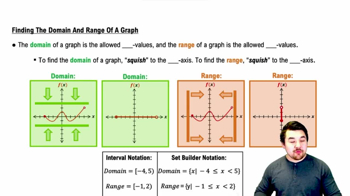
Understanding the domain of f(x) = x^2 * ln(1/x) is crucial since ln(1/x) is defined only for x > 0. Analyzing the behavior near the boundaries (as x approaches 0 and infinity) helps identify potential maximum values and ensures the function is well-defined where we search for extrema.
Recommended video:
5:10
Finding the Domain and Range of a Graph

Finding Critical Points Using Derivatives

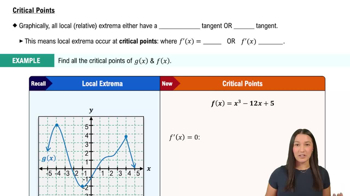
To find absolute maxima, compute the derivative f'(x) and solve f'(x) = 0 to locate critical points. These points are candidates for local maxima or minima. Differentiation involves applying the product and chain rules to handle the x^2 and ln(1/x) terms.
Recommended video:
04:50
Critical Points

Evaluating Absolute Maximum Values

After finding critical points, evaluate f(x) at these points and at the domain boundaries to determine the absolute maximum. Comparing these values identifies where the function attains its highest value, ensuring a complete analysis of maxima.
Recommended video:
5:10
Evaluate Composite Functions - Values on Unit Circle