Ch. 7 - Transcendental Functions
Hass - Thomas' Calculus 15th Edition
Hass15th EditionThomas' CalculusISBN: 9780137616077Not the one you use?Change textbook
Chapter 7, Problem 7.5.7

Use l’Hôpital’s rule to find the limits in Exercises 7–52.


7. lim (x → 2) (x - 2) / (x² - 4)

Verified step by step guidance
1
First, recognize that the limit is of the form \( \frac{0}{0} \) when \( x \to 2 \), since substituting \( x = 2 \) gives \( \frac{2 - 2}{2^2 - 4} = \frac{0}{0} \). This indeterminate form allows us to apply l'Hôpital's Rule.
Recall l'Hôpital's Rule states that if \( \lim_{x \to a} \frac{f(x)}{g(x)} \) results in \( \frac{0}{0} \) or \( \frac{\infty}{\infty} \), then \( \lim_{x \to a} \frac{f(x)}{g(x)} = \lim_{x \to a} \frac{f'(x)}{g'(x)} \), provided the latter limit exists.
Differentiate the numerator and denominator separately: \( f(x) = x - 2 \) so \( f'(x) = 1 \), and \( g(x) = x^2 - 4 \) so \( g'(x) = 2x \).
Rewrite the limit using the derivatives: \( \lim_{x \to 2} \frac{f'(x)}{g'(x)} = \lim_{x \to 2} \frac{1}{2x} \).
Finally, evaluate the new limit by substituting \( x = 2 \) into the expression \( \frac{1}{2x} \), which will give the value of the original limit.

Verified video answer for a similar problem:

This video solution was recommended by our tutors as helpful for the problem above.
Video duration:
2m
Was this helpful?

Key Concepts

Here are the essential concepts you must grasp in order to answer the question correctly.

Limits and Indeterminate Forms

Limits describe the behavior of a function as the input approaches a certain value. When direct substitution results in an indeterminate form like 0/0, special techniques such as l’Hôpital’s rule are needed to evaluate the limit.
Recommended video:
05:50
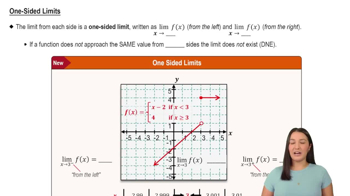
One-Sided Limits

l’Hôpital’s Rule

l’Hôpital’s rule states that if a limit yields an indeterminate form 0/0 or ∞/∞, the limit of the ratio of the functions equals the limit of the ratio of their derivatives, provided this latter limit exists.
Recommended video:

Derivative of Functions

Derivatives measure the instantaneous rate of change of a function. Applying l’Hôpital’s rule requires finding the derivatives of the numerator and denominator functions to simplify the limit evaluation.
Recommended video:
06:30
Derivatives of Other Trig Functions