Ch. 7 - Transcendental Functions
Hass - Thomas' Calculus 15th Edition
Hass15th EditionThomas' CalculusISBN: 9780137616077Not the one you use?Change textbook
Chapter 7, Problem 7.4.11

Solve the differential equation in Exercises 9–22.
11. (dy/dx) = e^(x-y)

Verified step by step guidance
1
Rewrite the given differential equation \( \frac{dy}{dx} = e^{x - y} \) to separate the variables \( y \) and \( x \). Start by expressing \( e^{x - y} \) as \( e^x \cdot e^{-y} \), so the equation becomes \( \frac{dy}{dx} = e^x e^{-y} \).
Separate the variables by multiplying both sides by \( e^y \) and multiplying both sides by \( dx \), giving \( e^y dy = e^x dx \). This puts all \( y \)-terms on one side and all \( x \)-terms on the other.
Integrate both sides: integrate \( e^y \) with respect to \( y \) on the left, and integrate \( e^x \) with respect to \( x \) on the right. This yields \( \int e^y dy = \int e^x dx \).
After integrating, write the general solution including the constant of integration \( C \). The integrals of \( e^y \) and \( e^x \) are both \( e^y \) and \( e^x \) respectively, so the equation becomes \( e^y = e^x + C \).
If needed, solve explicitly for \( y \) by taking the natural logarithm of both sides, resulting in \( y = \ln(e^x + C) \), which represents the implicit or explicit general solution to the differential equation.

Verified video answer for a similar problem:

This video solution was recommended by our tutors as helpful for the problem above.
Video duration:
2m
Was this helpful?

Key Concepts

Here are the essential concepts you must grasp in order to answer the question correctly.

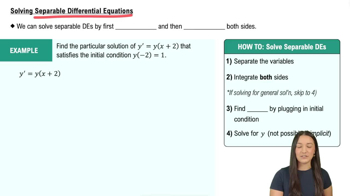
Separable Differential Equations

A separable differential equation can be written as a product of a function of x and a function of y, allowing variables to be separated on opposite sides of the equation. This enables integration with respect to each variable independently to find the solution.
Recommended video:
06:06
Solving Separable Differential Equations

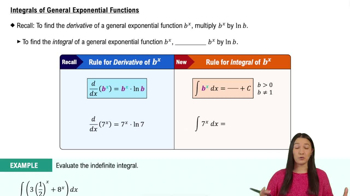
Integration of Exponential Functions

Integrating exponential functions involves recognizing the form e^(u) and applying substitution if necessary. The integral of e^(u) with respect to u is e^(u) plus a constant, which is essential when solving differential equations involving exponentials.
Recommended video:
05:11
Integrals of General Exponential Functions

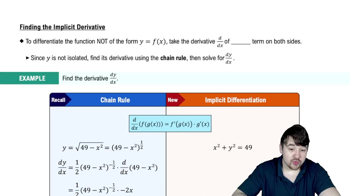
Implicit and Explicit Solutions

Solutions to differential equations can be implicit, where y is defined implicitly by an equation involving both x and y, or explicit, where y is expressed directly as a function of x. Understanding both forms helps interpret and verify solutions.
Recommended video:
05:14
Finding The Implicit Derivative