Ch. 7 - Transcendental Functions
Hass - Thomas' Calculus 15th Edition
Hass15th EditionThomas' CalculusISBN: 9780137616077Not the one you use?Change textbook
Chapter 7, Problem 7.6.87

Evaluate the integrals in Exercises 77–90.
87. ∫(x²+2x-1)/(x²+9) dx

Verified step by step guidance
1
Start by rewriting the integral: \(\int \frac{x^{2} + 2x - 1}{x^{2} + 9} \, dx\).
Split the integral into separate parts by expressing the numerator in a form related to the denominator: write \(x^{2} + 2x - 1\) as \((x^{2} + 9) + (2x - 10)\), so the integral becomes \(\int \frac{x^{2} + 9}{x^{2} + 9} \, dx + \int \frac{2x - 10}{x^{2} + 9} \, dx\).
Simplify the first integral to \(\int 1 \, dx\), and keep the second integral as \(\int \frac{2x - 10}{x^{2} + 9} \, dx\).
For the second integral, split it into two integrals: \(\int \frac{2x}{x^{2} + 9} \, dx - \int \frac{10}{x^{2} + 9} \, dx\). Use substitution for the first part and recognize the standard form for the second part.
Use substitution \(u = x^{2} + 9\) for \(\int \frac{2x}{x^{2} + 9} \, dx\), and recall that \(\int \frac{1}{x^{2} + a^{2}} \, dx = \frac{1}{a} \arctan \left( \frac{x}{a} \right) + C\) for the second integral.

Verified video answer for a similar problem:

This video solution was recommended by our tutors as helpful for the problem above.
Video duration:
7m
Was this helpful?

Key Concepts

Here are the essential concepts you must grasp in order to answer the question correctly.

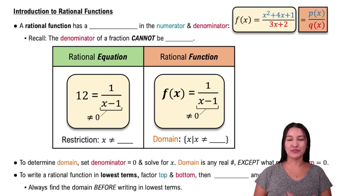
Integration of Rational Functions

This involves integrating functions expressed as the ratio of two polynomials. Techniques often include polynomial division, partial fraction decomposition, or algebraic manipulation to simplify the integrand before integration.
Recommended video:
6:04
Intro to Rational Functions

Polynomial Division

When the degree of the numerator is equal to or greater than the denominator, polynomial division helps rewrite the integrand as a polynomial plus a proper fraction, simplifying the integral into more manageable parts.
Recommended video:
07:00
Taylor Polynomials

Standard Integral Forms Involving Quadratics

Integrals with denominators like x² + a² often lead to inverse trigonometric functions such as arctangent. Recognizing these forms allows direct application of known integral formulas to solve the problem efficiently.
Recommended video:
3:40
Circles in Standard Form Example 1