Ch. 7 - Transcendental Functions
Hass - Thomas' Calculus 15th Edition
Hass15th EditionThomas' CalculusISBN: 9780137616077Not the one you use?Change textbook
Chapter 7, Problem 7.3.137

137. Find a curve through the origin in the xy-plane whose length from x = 0 to x = 1 is L = ∫ from 0 to 1 of sqrt(1 + (1/4)e^x) dx.

Verified step by step guidance
1
Recognize that the problem asks for a curve \( y = f(x) \) passing through the origin \( (0,0) \) whose arc length from \( x=0 \) to \( x=1 \) is given by \( L = \int_0^1 \sqrt{1 + \frac{1}{4} e^x} \, dx \).
Recall the formula for the arc length of a curve \( y = f(x) \) from \( x=a \) to \( x=b \): \[ L = \int_a^b \sqrt{1 + \left(\frac{dy}{dx}\right)^2} \, dx \]
Compare the given integral's integrand \( \sqrt{1 + \frac{1}{4} e^x} \) with the arc length formula's integrand \( \sqrt{1 + (y')^2} \). This implies: \[ 1 + \left(\frac{dy}{dx}\right)^2 = 1 + \frac{1}{4} e^x \] which simplifies to: \[ \left(\frac{dy}{dx}\right)^2 = \frac{1}{4} e^x \]
Take the square root of both sides to find \( \frac{dy}{dx} \): \[ \frac{dy}{dx} = \pm \frac{1}{2} e^{x/2} \] Choose the positive root to find an increasing function (or negative if decreasing is desired).
Integrate \( \frac{dy}{dx} = \frac{1}{2} e^{x/2} \) with respect to \( x \) to find \( y(x) \): \[ y = \int \frac{1}{2} e^{x/2} \, dx + C \] Use the initial condition \( y(0) = 0 \) to solve for \( C \).

Verified video answer for a similar problem:

This video solution was recommended by our tutors as helpful for the problem above.
Video duration:
2m
Was this helpful?

Key Concepts

Here are the essential concepts you must grasp in order to answer the question correctly.

Arc Length of a Curve

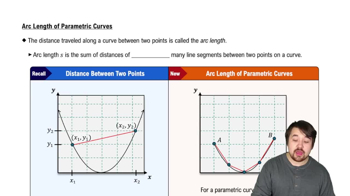
The arc length of a curve y = f(x) from x = a to x = b is given by the integral L = ∫ from a to b of sqrt(1 + (dy/dx)^2) dx. This formula measures the distance along the curve by summing infinitesimal line segments, accounting for both horizontal and vertical changes.
Recommended video:
06:29
Arc Length of Parametric Curves

Differential Equation from Arc Length

Given an arc length integral involving sqrt(1 + (dy/dx)^2), we can form a differential equation by equating the integrand to sqrt(1 + (dy/dx)^2). Solving this equation for dy/dx allows us to find the function y(x) that produces the specified arc length.
Recommended video:
06:29
Arc Length of Parametric Curves

Initial Condition and Integration

Since the curve passes through the origin, the initial condition y(0) = 0 is used to determine the constant of integration after solving the differential equation. Integrating dy/dx with this condition yields the explicit form of the curve y(x).
Recommended video:
05:03
Initial Value Problems