Ch. 7 - Transcendental Functions
Hass - Thomas' Calculus 15th Edition
Hass15th EditionThomas' CalculusISBN: 9780137616077Not the one you use?Change textbook
Chapter 7, Problem 7.5.77a

77. Which one is correct, and which one is wrong? Give reasons for your answers.
a. lim (x → 3) (x - 3) / (x² - 3) = lim (x → 3) 1 / (2x) = 1/6

Verified step by step guidance
1
Step 1: Identify the original limit expression: \(\lim_{x \to 3} \frac{x - 3}{x^{2} - 3}\).
Step 2: Check if direct substitution is possible by plugging \(x = 3\) into the expression: numerator becomes \(3 - 3 = 0\), denominator becomes \(3^{2} - 3 = 9 - 3 = 6\), so the expression evaluates to \(\frac{0}{6} = 0\).
Step 3: Notice that the original limit expression simplifies to \(\frac{0}{6} = 0\), so the limit should be 0, not \(\frac{1}{6}\).
Step 4: Analyze the second expression given: \(\lim_{x \to 3} \frac{1}{2x} = \frac{1}{6}\). This limit is correct for the function \(\frac{1}{2x}\), but it is not equivalent to the original limit expression.
Step 5: Conclude that the first limit expression is correct and equals 0, while the second expression is unrelated to the original limit and thus incorrect in this context.

Verified video answer for a similar problem:

This video solution was recommended by our tutors as helpful for the problem above.
Video duration:
2m
Was this helpful?

Key Concepts

Here are the essential concepts you must grasp in order to answer the question correctly.

Limit of a Function

The limit of a function as x approaches a value describes the behavior of the function near that point. It helps determine the value the function approaches, even if it is not defined at that point. Understanding limits is essential for evaluating expressions that may initially appear undefined.
Recommended video:
06:11
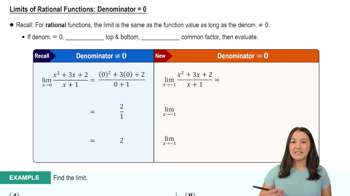
Limits of Rational Functions: Denominator = 0

Direct Substitution and Indeterminate Forms

Direct substitution involves plugging the approaching value into the function to find the limit. However, if this results in an indeterminate form like 0/0, further algebraic manipulation or techniques like factoring or L'Hôpital's Rule are needed to evaluate the limit correctly.
Recommended video:
05:21
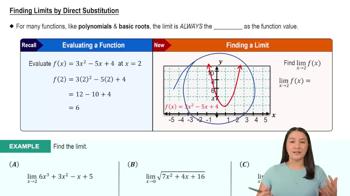
Finding Limits by Direct Substitution

Algebraic Simplification in Limits

Simplifying expressions algebraically before taking limits can resolve indeterminate forms. For example, factoring numerator and denominator or canceling common terms can reveal the true behavior of the function near the point, enabling accurate limit evaluation.
Recommended video:
05:21
Finding Limits by Direct Substitution