Ch. 7 - Transcendental Functions
Hass - Thomas' Calculus 15th Edition
Hass15th EditionThomas' CalculusISBN: 9780137616077Not the one you use?Change textbook
Chapter 7, Problem 7.1.44c

In Exercises 41–44:


c. Evaluate df/dx at x = a and df⁻¹/dx at x = f(a) to show that
(df⁻¹/dx)|ₓ₌f(a) = 1 / (df/dx)|ₓ₌a


44. f(x) = 2x², x ≥ 0, a = 5

Verified step by step guidance
1
First, identify the function and the point at which you need to evaluate the derivatives. Here, the function is \(f(x) = 2x^{2}\) with \(x \geq 0\), and the point is \(a = 5\).
Calculate the derivative of \(f(x)\) with respect to \(x\). Use the power rule: \(\frac{d}{dx} (2x^{2}) = 2 \cdot 2x^{2-1} = 4x\). So, \(\frac{df}{dx} = 4x\).
Evaluate \(\frac{df}{dx}\) at \(x = a = 5\). This gives \(\left. \frac{df}{dx} \right|_{x=5} = 4 \times 5\).
Next, find the inverse function \(f^{-1}(x)\). Since \(f(x) = 2x^{2}\) and \(x \geq 0\), solve for \(x\) in terms of \(y\): \(y = 2x^{2} \Rightarrow x = \sqrt{\frac{y}{2}}\). Thus, \(f^{-1}(x) = \sqrt{\frac{x}{2}}\).
Calculate the derivative of the inverse function \(f^{-1}(x)\) with respect to \(x\). Using the chain rule, \(\frac{d}{dx} \left( \sqrt{\frac{x}{2}} \right) = \frac{1}{2} \left( \frac{x}{2} \right)^{-\frac{1}{2}} \cdot \frac{1}{2} = \frac{1}{4} \left( \frac{x}{2} \right)^{-\frac{1}{2}}\). Then, evaluate this derivative at \(x = f(a) = f(5) = 2 \times 5^{2}\).

Verified video answer for a similar problem:

This video solution was recommended by our tutors as helpful for the problem above.
Video duration:
3m
Was this helpful?

Key Concepts

Here are the essential concepts you must grasp in order to answer the question correctly.

Derivative of a Function

The derivative of a function f(x) at a point x = a represents the instantaneous rate of change or slope of the function at that point. It is found by taking the limit of the difference quotient as the interval approaches zero. For example, if f(x) = 2x², then df/dx = 4x, and at x = 5, df/dx = 20.
Recommended video:
06:30
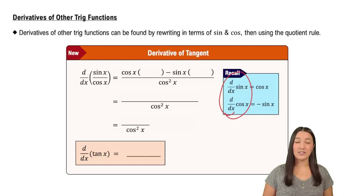
Derivatives of Other Trig Functions

Inverse Function and Its Derivative

An inverse function f⁻¹(x) reverses the effect of f(x), so that f(f⁻¹(x)) = x. The derivative of the inverse function at a point x = f(a) relates to the derivative of the original function at x = a. Specifically, (df⁻¹/dx) at x = f(a) equals the reciprocal of (df/dx) at x = a, provided the derivative is nonzero.
Recommended video:
06:35
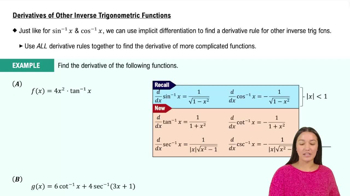
Derivatives of Other Inverse Trigonometric Functions

Chain Rule and Its Application to Inverse Functions

The chain rule states that the derivative of a composite function is the product of the derivatives of the inner and outer functions. Applying this to f(f⁻¹(x)) = x, differentiating both sides yields (df/dx)|ₓ₌f⁻¹(x) * (df⁻¹/dx) = 1. This relationship is key to proving that the derivative of the inverse is the reciprocal of the original function's derivative.
Recommended video:
03:58
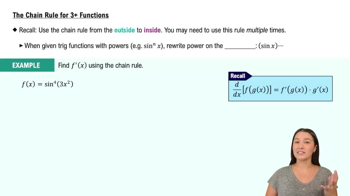
The Chain Rule for 3+ Functions