
Ch. 10 - Sequences and Infinite Series
Briggs - Calculus: Early Transcendentals 3rd Edition
Briggs3rd EditionCalculus: Early TranscendentalsISBN: 9780136847243Not the one you use?Change textbook
Chapter 10, Problem 10.R.37

27–37. Evaluating series Evaluate the following infinite series or state that the series diverges.
∑ (from k = 1 to ∞)2ᵏ / 3ᵏ⁺²

Verified step by step guidance
1
Identify the given series: \( \sum_{k=1}^{\infty} \frac{2^k}{3^{k+2}} \). Notice that the series involves terms with exponents depending on \(k\).
Rewrite the general term to separate the powers of 3: \( \frac{2^k}{3^{k+2}} = \frac{2^k}{3^k \cdot 3^2} = \frac{1}{3^2} \cdot \frac{2^k}{3^k} = \frac{1}{9} \cdot \left( \frac{2}{3} \right)^k \).
Recognize that the series is a geometric series with the first term \( a = \frac{1}{9} \cdot \left( \frac{2}{3} \right)^1 = \frac{2}{27} \) and common ratio \( r = \frac{2}{3} \).
Check the convergence of the geometric series by verifying if \( |r| < 1 \). Since \( \frac{2}{3} < 1 \), the series converges.
Use the formula for the sum of an infinite geometric series starting at \( k=1 \): \[ S = a \cdot \frac{1}{1 - r} \], where \( a \) is the first term and \( r \) is the common ratio. Substitute the values to express the sum.

Verified video answer for a similar problem:

This video solution was recommended by our tutors as helpful for the problem above.
Video duration:
3m
Was this helpful?

Key Concepts

Here are the essential concepts you must grasp in order to answer the question correctly.

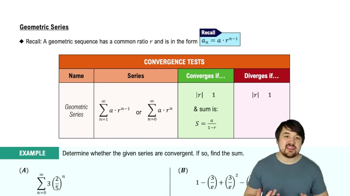
Infinite Geometric Series

An infinite geometric series is a sum of terms where each term is found by multiplying the previous term by a constant ratio. It converges if the absolute value of the ratio is less than 1, and its sum can be calculated using the formula S = a / (1 - r), where a is the first term and r is the common ratio.
Recommended video:
06:00
Geometric Series

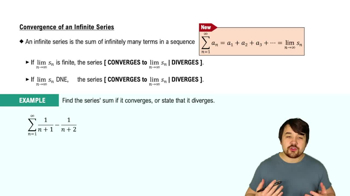
Convergence and Divergence of Series

A series converges if the sum of its infinite terms approaches a finite limit; otherwise, it diverges. For geometric series, convergence depends on the common ratio's magnitude. Understanding convergence is essential to determine whether the series sum exists or not.
Recommended video:
06:52
Convergence of an Infinite Series

Manipulating Series Terms

Simplifying the general term of a series often involves algebraic manipulation, such as factoring exponents or rewriting terms to identify the first term and common ratio. This step is crucial to apply known formulas and test for convergence effectively.
Recommended video:
06:00
Geometric Series
Related Practice
Textbook Question

88–89. Binary numbers

Humans use the ten digits 0 through 9 to form base-10 or decimal numbers, whereas computers calculate and store numbers internally as binary numbers—numbers consisting entirely of 0’s and 1’s. For this exercise, we consider binary numbers that have the form 0.b₁b₂b₃⋯, where each of the digits b₁, b₂, b₃, ⋯ is either 0 or 1. The base-10 representation of the binary number 0.b₁b₂b₃⋯ is the infinite series

b₁ / 2¹ + b₂ / 2² + b₃ / 2³ + ⋯


89. Computers can store only a finite number of digits and therefore numbers with nonterminating digits must be rounded or truncated before they can be used and stored by a computer.


a. Find the base-10 representation of the binary number 0.001̅1.

1
views
Textbook Question

12–24. Limits of sequences Evaluate the limit of the sequence or state that it does not exist.

aₙ = ((3n² + 2n + 1) · sin(n)) / (4n³ + n) (Hint: Use the Squeeze Theorem.)

1
views
Textbook Question

12–24. Limits of sequences Evaluate the limit of the sequence or state that it does not exist.

aₙ = (–1)ⁿ / 0.9ⁿ

1
views
Textbook Question

Express 0.314141414… as a ratio of two integers.

Textbook Question

Give an example (if possible) of a sequence {aₖ} that converges, while the series ∑ (from k = 1 to ∞) aₖ diverges.

1
views
Textbook Question

Explain why or why not

Determine whether the following statements are true and give an explanation or counterexample.


e.The sequence aₙ = n² / (n² + 1) converge.

1
views