
Textbook Question
Given three polar coordinate representations for the origin.
1
views

 Verified step by step guidance
 08:02
08:02
 05:59
05:59 02:59
02:59Given three polar coordinate representations for the origin.
33–40. Areas of regions Make a sketch of the region and its bounding curves. Find the area of the region.
The region inside the limaçon r = 2 + cos θ
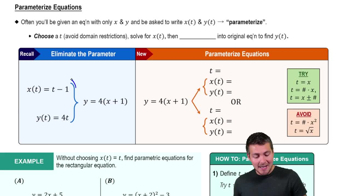
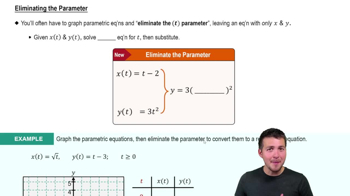
15–30. Working with parametric equations Consider the following parametric equations.
a. Eliminate the parameter to obtain an equation in x and y.
b. Describe the curve and indicate the positive orientation.
x = 3 cos t, y = 3 sin t; π ≤ t ≤ 2π
15–22. Sets in polar coordinates Sketch the following sets of points.
2 ≤ r ≤ 8
13–30. Graphing conic sections Determine whether the following equations describe a parabola, an ellipse, or a hyperbola, and then sketch a graph of the curve. For each parabola, specify the location of the focus and the equation of the directrix; for each ellipse, label the coordinates of the vertices and foci, and find the lengths of the major and minor axes; for each hyperbola, label the coordinates of the vertices and foci, and find the equations of the asymptotes.
4x = -y²
63–74. Arc length of polar curves Find the length of the following polar curves.
The complete circle r = a sin θ, where a > 0