If ƒ(x) = √x and g(x) = x³-2 and , simplify the expressions (ƒ o g) (3), (ƒ o ƒ) (64), (g o ƒ) (x) and (ƒ o g) (x)
Ch. 1 - Functions
Briggs3rd EditionCalculus: Early TranscendentalsISBN: 9780136847243Not the one you use?Change textbook
Chapter 1, Problem 14c
Use the graph of in the figure to plot the following functions.
<IMAGE>
Verified step by step guidance1
Identify the transformation involved in the function y = f(x - 2). This represents a horizontal shift of the graph of f(x) to the right by 2 units.
Examine the key points on the original graph of f(x). These points will help in accurately shifting the graph.
Shift each key point of the graph of f(x) 2 units to the right. For example, if a point on f(x) is (a, b), it will become (a+2, b) on the graph of y = f(x - 2).
Redraw the graph using the shifted points to represent y = f(x - 2). Ensure that the shape and orientation of the graph remain unchanged, only the position is altered.
Verify the transformation by checking that all points have been shifted correctly and the overall graph maintains the same features as the original, just translated horizontally.

Verified video answer for a similar problem:
This video solution was recommended by our tutors as helpful for the problem above.
Video duration:
4mWas this helpful?
Key Concepts
Here are the essential concepts you must grasp in order to answer the question correctly.
Function Transformation
Function transformation refers to the process of altering the graph of a function through various operations, such as shifting, stretching, or reflecting. In the context of the question, the function y = f(x - 2) represents a horizontal shift of the original function f by 2 units to the right. Understanding how these transformations affect the graph is crucial for accurately plotting the new function.
Recommended video:
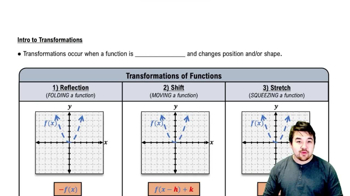
Intro to Transformations
Graphing Functions
Graphing functions involves plotting points on a coordinate system to visually represent the relationship between the input (x-values) and output (y-values) of a function. This process requires knowledge of the function's behavior, including its intercepts, asymptotes, and overall shape. In this question, students must apply their graphing skills to represent the transformed function based on the original graph of f.
Recommended video:
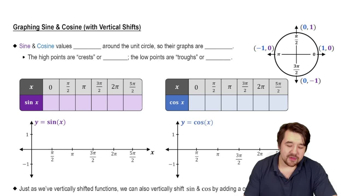
Graph of Sine and Cosine Function
Horizontal Shifts
Horizontal shifts occur when a function is modified by adding or subtracting a constant to the input variable. Specifically, in the function y = f(x - 2), the '-2' indicates a shift to the right by 2 units. This concept is essential for understanding how the graph of the function changes position on the x-axis, which directly impacts the overall appearance of the graph.
Recommended video:
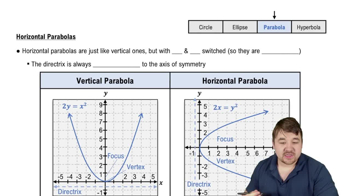
Horizontal Parabolas
Related Practice
Textbook Question
1
views
Textbook Question
The parabola y=x²+1 consists of two one-to-one functions, g₁(x) and g₂(x). Complete each exercise and confirm that your answers are consistent with the graphs displayed in the figure. <IMAGE>
Find formulas for g₁((x) and g₁⁻¹(x). State the domain and range of each function.
1
views
Textbook Question
Find functions ƒand g such that ƒ(g(x)) = (x² +1)⁵ . Find a different pair of functions ƒ and g that also satisfy ƒ(g(x)) = (x² +1)⁵
Textbook Question
Use the graphs of ƒ and g in the figure to determine the following function values. y = f(x) ; y=g(x) <IMAGE>
a. (ƒ o g ) (2)
Textbook Question
Evaluate cos⁻¹(cos(5π/4)).
3
views
Textbook Question
Use the graph of in the figure to plot the following functions.
<IMAGE>
6
views