
Ch. 1 - Functions
Briggs - Calculus: Early Transcendentals 3rd Edition
Briggs3rd EditionCalculus: Early TranscendentalsISBN: 9780136847243Not the one you use?Change textbook
Chapter 1, Problem 14

If ƒ(x) = √x and g(x) = x³-2 and , simplify the expressions (ƒ o g) (3), (ƒ o ƒ) (64), (g o ƒ) (x) and (ƒ o g) (x)

Verified step by step guidance
1
Step 1: Understand the composition of functions. The notation (f o g)(x) means f(g(x)), which means you first apply g to x, and then apply f to the result.
Step 2: Calculate (f o g)(3). First, find g(3) by substituting 3 into g(x) = x^3 - 2, then apply f to the result.
Step 3: Calculate (f o f)(64). First, find f(64) by substituting 64 into f(x) = \(\sqrt{x}\), then apply f to the result.
Step 4: Calculate (g o f)(x). First, find f(x) by substituting x into f(x) = \(\sqrt{x}\), then apply g to the result.
Step 5: Calculate (f o g)(x). First, find g(x) by substituting x into g(x) = x^3 - 2, then apply f to the result.

Verified video answer for a similar problem:

This video solution was recommended by our tutors as helpful for the problem above.
Video duration:
3m
Was this helpful?

Key Concepts

Here are the essential concepts you must grasp in order to answer the question correctly.

Function Composition

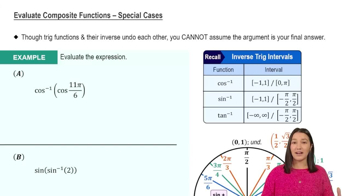
Function composition involves combining two functions where the output of one function becomes the input of another. For example, if you have functions f(x) and g(x), the composition (f o g)(x) means you first apply g to x, then apply f to the result of g. Understanding this concept is crucial for simplifying expressions involving multiple functions.
Recommended video:
3:48
Evaluate Composite Functions - Special Cases

Square Root Function

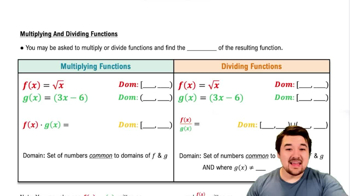
The square root function, denoted as f(x) = √x, is defined for non-negative values of x and returns the principal square root. This function is essential in the given problem as it affects the output of the composed functions, particularly when evaluating expressions like (f o g)(3) and (f o f)(64). Recognizing the domain restrictions of the square root function is important for valid outputs.
Recommended video:
7:24
Multiplying & Dividing Functions

Polynomial Functions

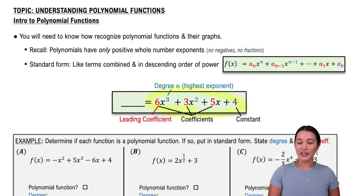
Polynomial functions, such as g(x) = x³ - 2, are expressions that involve variables raised to whole number powers. They are continuous and differentiable everywhere on their domain. In the context of the question, understanding how to evaluate and manipulate polynomial functions is necessary for simplifying expressions like (g o f)(x) and (f o g)(x).
Recommended video:
6:04
Introduction to Polynomial Functions