Ch. 1 - Functions
Briggs - Calculus: Early Transcendentals 3rd Edition
Briggs3rd EditionCalculus: Early TranscendentalsISBN: 9780136847243Not the one you use?Change textbook
Chapter 1, Problem 14e

Use the graph of ff in the figure to plot the following functions.
<IMAGE>
y=f(x1)+2y=f\(\left\)(x-1\(\right\))+2

Verified step by step guidance
1
Identify the transformation components in the function y = f(x-1) + 2. The function involves a horizontal shift and a vertical shift.
Recognize that the expression (x-1) indicates a horizontal shift. Specifically, f(x-1) represents a shift of the graph of f(x) to the right by 1 unit.
Understand that the '+2' outside the function indicates a vertical shift. This means that after shifting the graph to the right, you will move it up by 2 units.
Start by taking each point on the original graph of f(x) and apply the horizontal shift. Move each point 1 unit to the right.
After applying the horizontal shift, apply the vertical shift by moving each of the new points 2 units up. Plot these new points to obtain the graph of y = f(x-1) + 2.

Verified video answer for a similar problem:

This video solution was recommended by our tutors as helpful for the problem above.
Video duration:
5m
Was this helpful?

Key Concepts

Here are the essential concepts you must grasp in order to answer the question correctly.

Function Transformation

Function transformation refers to the changes made to the graph of a function through operations such as shifting, stretching, or reflecting. In the given equation, y = f(x - 1) + 2, the function f is shifted to the right by 1 unit and then raised vertically by 2 units. Understanding these transformations is crucial for accurately plotting the new function based on the original graph.
Recommended video:
5:25
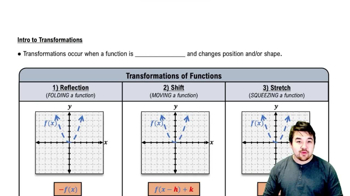
Intro to Transformations

Horizontal Shift

A horizontal shift occurs when a function is moved left or right along the x-axis. In the expression f(x - 1), the subtraction of 1 indicates a shift to the right by 1 unit. This concept is essential for determining how the input values of the function are altered, affecting the overall position of the graph.
Recommended video:
5:28
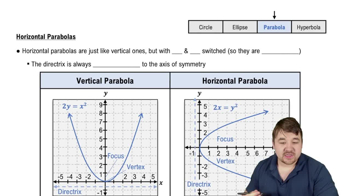
Horizontal Parabolas

Vertical Shift

A vertical shift involves moving a function up or down along the y-axis. In the equation y = f(x - 1) + 2, the addition of 2 results in a vertical shift upwards by 2 units. This concept helps in understanding how the output values of the function are adjusted, which is necessary for accurately plotting the transformed function.
Recommended video:
5:30
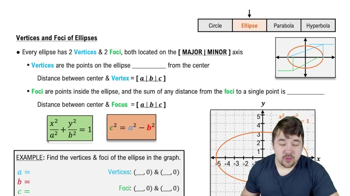
Foci and Vertices of an Ellipse