Ch. 1 - Functions
Briggs - Calculus: Early Transcendentals 3rd Edition
Briggs3rd EditionCalculus: Early TranscendentalsISBN: 9780136847243Not the one you use?Change textbook
Chapter 1, Problem 15a

Use the graphs of ƒ and g in the figure to determine the following function values. y = f(x) ; y=g(x) <IMAGE>


a. (ƒ o g ) (2)

Verified step by step guidance
1
Identify the function composition (f o g)(x), which means f(g(x)).
Determine the value of g(2) by locating x = 2 on the graph of g and finding the corresponding y-value.
Use the y-value obtained from g(2) as the input for the function f.
Locate this new input on the graph of f to find the corresponding y-value, which is f(g(2)).
The y-value found in the previous step is the value of (f o g)(2).

Verified video answer for a similar problem:

This video solution was recommended by our tutors as helpful for the problem above.
Video duration:
2m
Was this helpful?

Key Concepts

Here are the essential concepts you must grasp in order to answer the question correctly.

Function Composition

Function composition involves combining two functions, where the output of one function becomes the input of another. In this case, (ƒ o g)(2) means you first evaluate g at 2, and then use that result as the input for the function ƒ. Understanding how to perform this operation is crucial for solving the problem.
Recommended video:
3:48
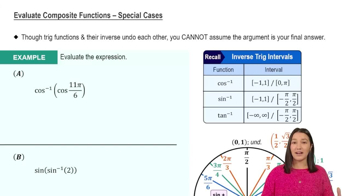
Evaluate Composite Functions - Special Cases

Evaluating Functions

Evaluating functions requires substituting a specific input value into the function's formula or graph. For instance, to find g(2), you would locate the point on the graph of g where x equals 2 and determine the corresponding y-value. This step is essential for finding the correct input for the next function in the composition.
Recommended video:
4:26
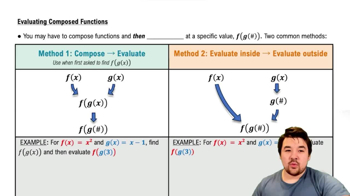
Evaluating Composed Functions

Graph Interpretation

Interpreting graphs is vital for understanding the behavior of functions visually. It involves analyzing the plotted points, slopes, and intersections to extract function values. In this question, you will need to read the graphs of ƒ and g accurately to find the necessary values for the composition.
Recommended video:
06:15
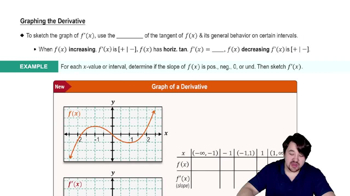
Graphing The Derivative