Ch. 7 The Axial Skeleton
Martini - Fundamentals of Anatomy and Physiology 12th Edition
Martini, Nath, Bartholomew12th EditionFundamentals of Anatomy and PhysiologyISBN: 9780137854011Not the one you use?Change textbook
Chapter 7, Problem 3

The unpaired facial bones include the:
(a) Lacrimal and nasal
(b) Vomer and mandible
(c) Maxilla and mandible
(d) Zygomatic and palatine

Verified step by step guidance
1
Step 1: Understand the difference between paired and unpaired facial bones. Paired bones occur as two symmetrical bones on each side of the face, while unpaired bones are single bones located along the midline of the face.
Step 2: Identify the bones listed in each option and determine whether they are paired or unpaired. For example, the lacrimal and nasal bones are paired, meaning there is one on each side of the face.
Step 3: Recall that the vomer is an unpaired bone forming part of the nasal septum, and the mandible is a single bone forming the lower jaw, so both are unpaired.
Step 4: Recognize that the maxilla, zygomatic, and palatine bones are paired bones, present on both sides of the face.
Step 5: Based on this analysis, select the option that correctly lists only unpaired facial bones.

Verified video answer for a similar problem:

This video solution was recommended by our tutors as helpful for the problem above.
Video duration:
2m
Was this helpful?

Key Concepts

Here are the essential concepts you must grasp in order to answer the question correctly.

Unpaired Facial Bones

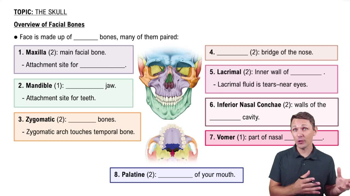
Unpaired facial bones are single bones located along the midline of the face, meaning there is only one of each. These bones are distinct from paired bones, which occur in symmetrical pairs on both sides of the face.
Recommended video:
Guided course
6:30
Overview of Facial Bones

Examples of Unpaired Facial Bones

The main unpaired facial bones include the mandible, which forms the lower jaw, and the vomer, which forms part of the nasal septum. Recognizing these helps differentiate them from paired bones like the maxilla or zygomatic bones.
Recommended video:
Guided course
6:30
Overview of Facial Bones

Paired vs. Unpaired Bone Identification

Understanding the difference between paired and unpaired bones is essential for anatomy. Paired bones appear on both sides of the face (e.g., nasal, lacrimal), while unpaired bones are singular and central, aiding in correctly answering questions about bone classification.
Recommended video:
Guided course
2:21
Microscopic Anatomy of Bones - Bone Cells Example 1