Ch. 7 The Axial Skeleton
Martini - Fundamentals of Anatomy and Physiology 12th Edition
Martini, Nath, Bartholomew12th EditionFundamentals of Anatomy and PhysiologyISBN: 9780137854011Not the one you use?Change textbook
Chapter 7, Problem 1

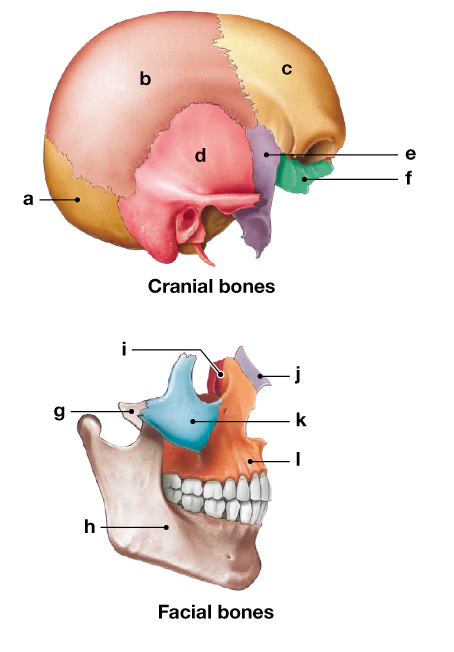
Identify the cranial and facial bones in the diagram below.
Diagram of the human skull showing labeled cranial and facial bones with lettered identification points.
a. ___
b. ___
c. ___
d. ___
e. ___
f. ___
g. ___
h. ___
i. ___
j. ___
k. ___
l. ___

Verified step by step guidance
1
Step 1: Identify the cranial bones in the upper diagram. These bones form the protective case around the brain. For example, the bone labeled 'b' is the parietal bone, 'c' is the frontal bone, and 'd' is the temporal bone.
Step 2: Recognize the facial bones in the lower diagram. These bones form the structure of the face. For instance, the bone labeled 'f' is the maxilla, 'g' is the nasal bone, and 'h' is the zygomatic bone.
Step 3: Match each letter to the corresponding bone by comparing the location and shape in the diagram. For example, 'a' is the occipital bone at the back of the skull, and 'i' is the mandible, the lower jawbone.
Step 4: Use anatomical landmarks such as the eye sockets, nasal cavity, and jawline to help distinguish between cranial and facial bones. For example, 'e' is the sphenoid bone, which is part of the cranial base.
Step 5: List all bones with their correct names based on their labels: a - occipital, b - parietal, c - frontal, d - temporal, e - sphenoid, f - maxilla, g - nasal, h - zygomatic, i - mandible, j - lacrimal, k - ethmoid, l - vomer.

Verified video answer for a similar problem:

This video solution was recommended by our tutors as helpful for the problem above.
Video duration:
2m
Was this helpful?

Key Concepts

Here are the essential concepts you must grasp in order to answer the question correctly.

Cranial Bones

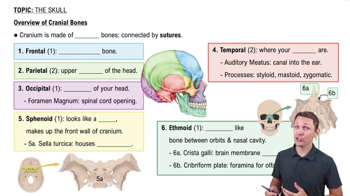
Cranial bones form the protective case around the brain. They include bones such as the frontal, parietal, temporal, occipital, sphenoid, and ethmoid. These bones are connected by sutures and provide attachment points for muscles involved in head movement and chewing.
Recommended video:
Guided course
8:20
Overview of Cranial Bones

Facial Bones

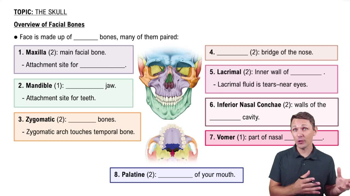
Facial bones shape the face and support the teeth. Key facial bones include the maxilla, mandible, nasal bones, zygomatic bones, lacrimal bones, palatine bones, inferior nasal conchae, and vomer. They form cavities for sensory organs and openings for air and food passage.
Recommended video:
Guided course
6:30
Overview of Facial Bones

Bone Identification in Diagrams

Identifying bones in anatomical diagrams requires recognizing their shape, location, and color coding. Labels often correspond to specific bones, and understanding the spatial relationship between cranial and facial bones helps in accurate identification. This skill is essential for anatomy studies and clinical applications.
Recommended video:
Guided course
2:37
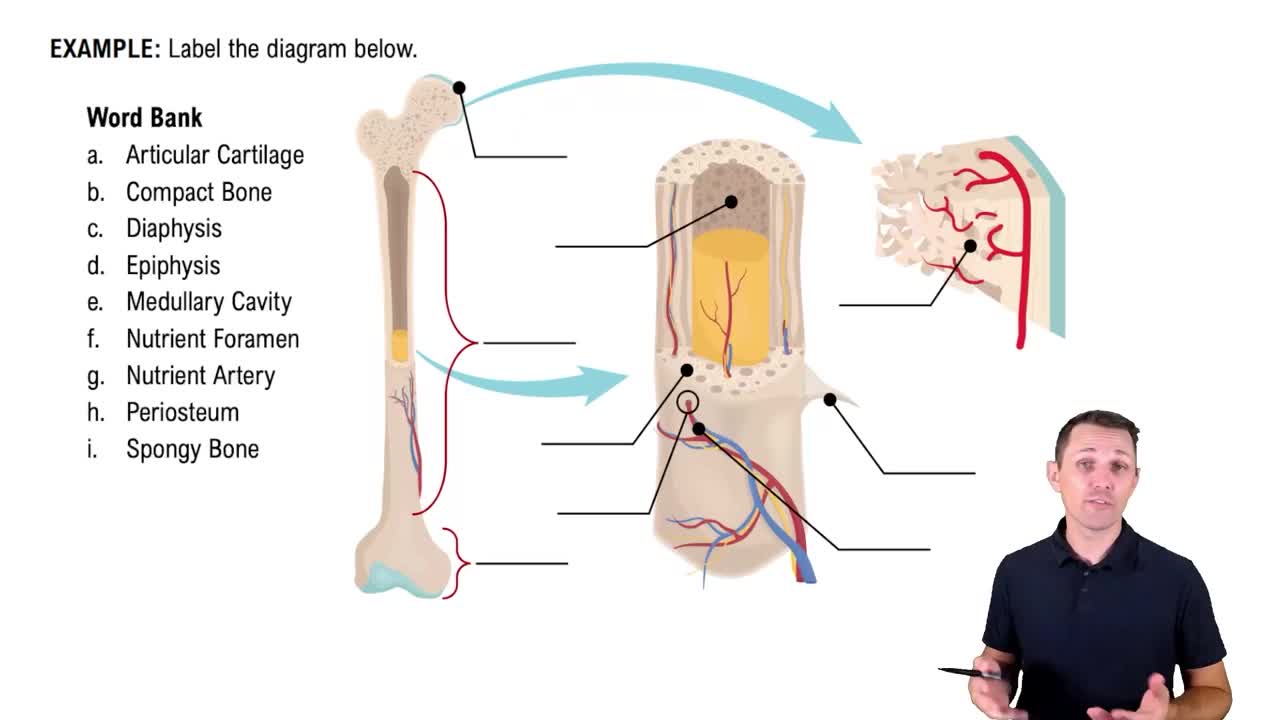
Gross Anatomy of Bones - Structure of a Long Bone Example 2