Ch. 7 The Axial Skeleton
Martini - Fundamentals of Anatomy and Physiology 12th Edition
Martini, Nath, Bartholomew12th EditionFundamentals of Anatomy and PhysiologyISBN: 9780137854011Not the one you use?Change textbook
Chapter 7, Problem 2

Which of the following lists contains only facial bones? (a) mandible, maxilla, nasal, zygomatic, (b) frontal, occipital, zygomatic, parietal, (c) occipital, sphenoid, temporal, lacrimal, (d) frontal, parietal, occipital, sphenoid.

Verified step by step guidance
1
Step 1: Understand the difference between facial bones and cranial bones. Facial bones primarily form the structure of the face, including the jaw, nose, and cheekbones, while cranial bones form the protective case around the brain.
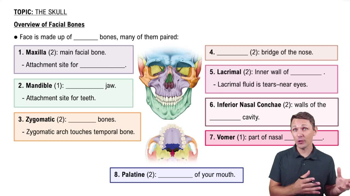
Step 2: Identify the facial bones from the options given. Common facial bones include the mandible, maxilla, nasal, zygomatic, lacrimal, palatine, vomer, and inferior nasal conchae.
Step 3: Review each list and check if all bones listed are facial bones. For example, in option (a), mandible, maxilla, nasal, and zygomatic are all facial bones.
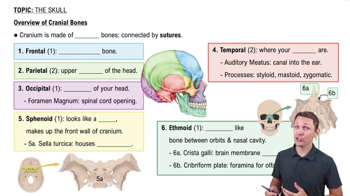
Step 4: Recognize that bones like frontal, occipital, parietal, sphenoid, and temporal are cranial bones, not facial bones. So any list containing these is not exclusively facial bones.
Step 5: Conclude which list contains only facial bones by confirming that every bone in that list is part of the facial skeleton.

Verified video answer for a similar problem:

This video solution was recommended by our tutors as helpful for the problem above.
Video duration:
2m
Was this helpful?

Key Concepts

Here are the essential concepts you must grasp in order to answer the question correctly.

Facial Bones

Facial bones form the structure of the face and support the entrances to the respiratory and digestive systems. Key facial bones include the mandible, maxilla, nasal, zygomatic, lacrimal, palatine, vomer, and inferior nasal conchae. These bones are distinct from cranial bones, which protect the brain.
Recommended video:
Guided course
6:30
Overview of Facial Bones

Cranial Bones

Cranial bones make up the skull's protective case around the brain. Major cranial bones include the frontal, parietal, occipital, temporal, sphenoid, and ethmoid bones. Recognizing these helps differentiate them from facial bones in anatomical classification.
Recommended video:
Guided course
8:20
Overview of Cranial Bones

Bone Identification and Classification

Understanding how to identify and classify bones based on their location and function is essential. This involves knowing which bones belong to the face versus the cranium, enabling accurate selection from lists or diagrams in anatomy questions.
Recommended video:
08:25
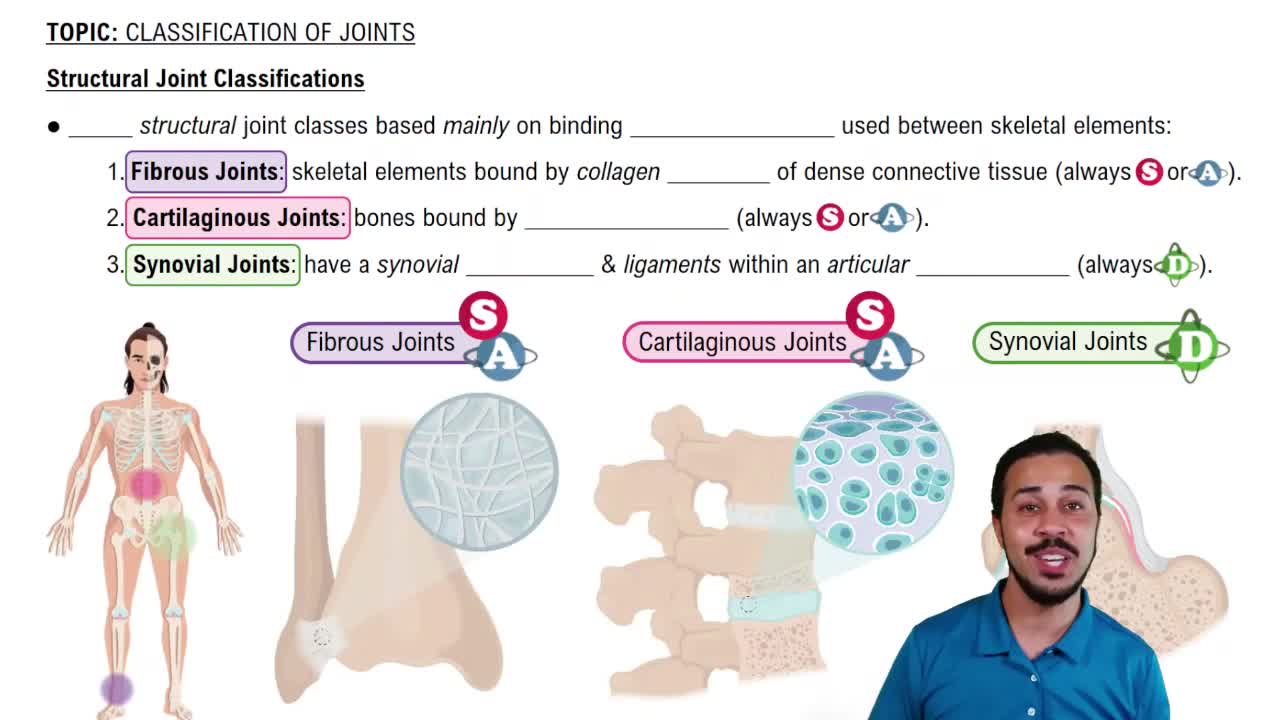
Structural Joint Classifications