
Ch. 2 The Chemistry of Life
Amerman- Human Anatomy & Physiology 3e
Amerman3rd EditionHuman Anatomy & PhysiologyISBN: 9780138247201, 9780138247928, 9780138201814Not the one you use?Change textbook
Chapter 2, Problem L3.2

Some claim that the pH of your blood can be affected by eating acidic foods such as citrus. Do you believe this to be true? Explain your answer. (Hint: What happens when extra hydrogen ions are added to the blood?)

Verified step by step guidance
1
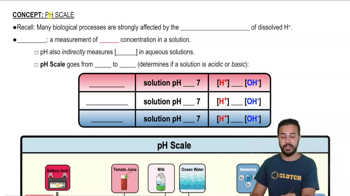
Understand the concept of pH: pH is a measure of hydrogen ion (H⁺) concentration in a solution. A lower pH indicates higher acidity (more H⁺ ions), while a higher pH indicates alkalinity (fewer H⁺ ions). Normal blood pH is tightly regulated between 7.35 and 7.45, which is slightly alkaline.
Learn about the body's buffering systems: The body has mechanisms, such as the bicarbonate buffer system, to maintain blood pH within its narrow range. The bicarbonate buffer system involves the equilibrium: \( \text{HCO}_3^- + \text{H}^+ \leftrightarrow \text{H}_2\text{CO}_3 \leftrightarrow \text{CO}_2 + \text{H}_2\text{O} \). This system helps neutralize excess H⁺ ions or hydroxide ions (OH⁻).
Consider the digestion process: When you eat acidic foods like citrus, the acids are neutralized in the stomach by gastric acid (which is already highly acidic, with a pH of around 1.5-3.5). The acidic food does not directly enter the bloodstream in its original form.
Examine the role of homeostasis: The kidneys and lungs work together to regulate blood pH. For example, the lungs can expel more CO₂ (a byproduct of the bicarbonate buffer system) to reduce acidity, while the kidneys can excrete H⁺ ions or reabsorb bicarbonate ions to maintain pH balance.
Conclude based on physiology: Eating acidic foods like citrus does not significantly affect blood pH because of the body's robust buffering systems and homeostatic mechanisms. Any minor changes in H⁺ ion concentration are quickly corrected to maintain the blood's pH within its normal range.

Verified video answer for a similar problem:

This video solution was recommended by our tutors as helpful for the problem above.
Was this helpful?

Key Concepts

Here are the essential concepts you must grasp in order to answer the question correctly.

pH and Hydrogen Ions

pH is a measure of the acidity or alkalinity of a solution, determined by the concentration of hydrogen ions (H+) present. A lower pH indicates higher acidity, while a higher pH indicates alkalinity. The addition of hydrogen ions to the blood can lower its pH, making it more acidic, which can disrupt normal physiological functions.
Recommended video:
07:58
pH Scale

Homeostasis in Blood pH

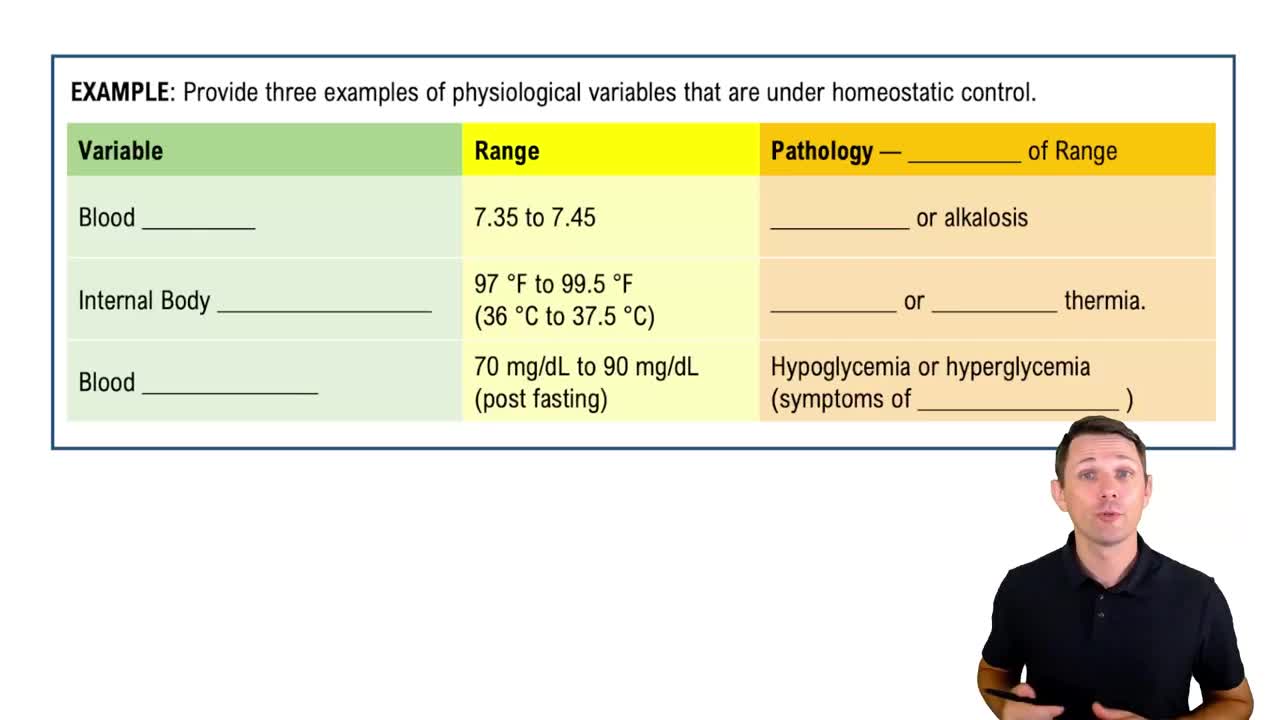
The body maintains blood pH within a narrow range (approximately 7.35 to 7.45) through homeostatic mechanisms. This regulation is crucial because even slight deviations can lead to acidosis or alkalosis, which can have serious health implications. The body employs buffers, respiratory control, and renal function to stabilize pH levels despite dietary changes.
Recommended video:
Guided course
03:46
Homeostasis Example 1

Dietary Impact on Blood pH

While certain foods, like citrus, are acidic, their effect on blood pH is minimal due to the body's regulatory systems. The digestion of food can produce metabolic byproducts that influence pH, but the body effectively neutralizes these changes. Therefore, the claim that eating acidic foods significantly alters blood pH is largely unfounded, as the body prioritizes maintaining homeostasis.
Recommended video:
07:58
pH Scale
Related Practice
Textbook Question

The drug methotrexate is used to treat several different types of cancer and diseases of the immune system. It works by inhibiting an enzyme in the cell necessary for folic acid synthesis. Without folic acid, the cell cannot make nucleotides. What, specifically, does an enzyme do in the cell? Why would inhibiting this enzyme disrupt folic acid synthesis? What effect would a disruption in folic acid synthesis have on the cell as a whole? (Hint: Think about the role that folic acid plays in the cell.) (Connects to Chapter 2)

1
views
Textbook Question

Explain how buffer systems in the body work if the pH of body fluids increases. Is this an example of a negative or a positive feedback loop? Explain.

1
views
Textbook Question

In certain types of radioactive decay, the isotope releases a particle called an alpha particle, which contains two protons and two neutrons. When this happens, is the product still the same element? Why or why not?

4
views
Textbook Question

Many drugs and poisons exert their effects by blocking one or more enzymes. How could blocking an enzyme lead to the death of a cell?

1
views
Textbook Question

The polysaccharide cellulose is not digestible by humans, as we lack the enzyme cellulase, which is required to break it down. Certain dietary supplements contain the enzyme cellulase and claim that being able to break down cellulose will help a person lose weight. But what do you think would happen if we could digest the cellulose we ate?

1
views
Textbook Question

Which of the following statements correctly describes a solution?

a. In a solution the solute is chemically dissolved by the solvent.

b. Solutions involve large particles suspended in another component.

c. The particles in a solution will settle out if left to sit.

d. The amount of solute in a solution is expressed as the solution's concentration.

1
views