Ch. 2 The Chemistry of Life
Amerman- Human Anatomy & Physiology 3e
Amerman3rd EditionHuman Anatomy & PhysiologyISBN: 9780138247201, 9780138247928, 9780138201814Not the one you use?Change textbook
Chapter 2, Problem L2.1

In certain types of radioactive decay, the isotope releases a particle called an alpha particle, which contains two protons and two neutrons. When this happens, is the product still the same element? Why or why not?

Verified step by step guidance
1
Step 1: Begin by understanding what an alpha particle is. An alpha particle consists of two protons and two neutrons, which means it has a mass number of 4 and a charge of +2.
Step 2: Recognize that when an isotope undergoes alpha decay, it loses an alpha particle. This results in a decrease in the atomic number (number of protons) by 2 and the mass number (total number of protons and neutrons) by 4.
Step 3: Recall that the atomic number determines the identity of an element. If the atomic number changes, the element itself changes because the number of protons defines the element.
Step 4: Use the periodic table to confirm that a decrease in atomic number by 2 means the element shifts to a different position on the table, corresponding to a new element.
Step 5: Conclude that the product of alpha decay is not the same element as the original isotope because the loss of two protons changes the atomic number, thereby changing the element's identity.

Verified video answer for a similar problem:

This video solution was recommended by our tutors as helpful for the problem above.
Was this helpful?

Key Concepts

Here are the essential concepts you must grasp in order to answer the question correctly.

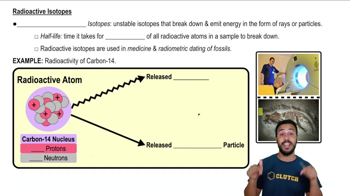
Radioactive Decay

Radioactive decay is a process by which unstable atomic nuclei lose energy by emitting radiation. This can occur in various forms, including alpha decay, where an alpha particle (composed of two protons and two neutrons) is released. This process transforms the original element into a different element due to the loss of protons.
Recommended video:
03:27
Radioactive Isotopes

Alpha Particle

An alpha particle is a type of ionizing radiation consisting of two protons and two neutrons, essentially a helium nucleus. When an atom undergoes alpha decay, it emits this particle, resulting in a decrease in the atomic number of the original element by two. This change in atomic number is crucial for determining whether the product is the same element.
Recommended video:
04:48
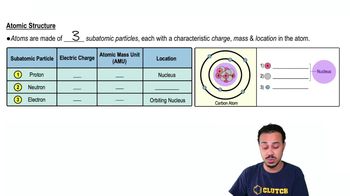
Atomic Structure

Element Identity

The identity of an element is defined by its atomic number, which is the number of protons in its nucleus. When an element emits an alpha particle, it loses two protons, thus changing its atomic number and transforming it into a different element. Therefore, the product of alpha decay is not the same element as the original.
Recommended video:
03:36
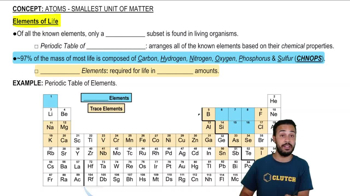
Elements of Life