
Ch. 10 Muscle Tissue and Physiology
Amerman- Human Anatomy & Physiology 3e
Amerman3rd EditionHuman Anatomy & PhysiologyISBN: 9780138247201, 9780138247928, 9780138201814Not the one you use?Change textbook
Chapter 10, Problem 21

Mark the following statements as true for smooth muscle tissue, cardiac muscle tissue, and/or skeletal muscle tissue.          
a. _________ Actin attaches to dense bodies.          
b. _________ Cells are joined by intercalated discs.          
c. _________ The thick and thin filaments are arranged into sarcomeres.          
d. _________ The thick filaments contain myosin heads along their entire length.          
e. _________ The cells depolarize and contract as a unit.          
f. _________ Ca2+ binding to troponin is the initiating event of contraction.          
g. _________ Ca2+ binding to calmodulin is the initiating event of contraction.          
h. _________ The sarcolemma has a distinct motor end plate.

Verified step by step guidance
1
Understand the characteristics of the three types of muscle tissue: smooth, cardiac, and skeletal. Smooth muscle is non-striated and involuntary, cardiac muscle is striated and involuntary, and skeletal muscle is striated and voluntary. This foundational knowledge will help match the statements to the correct muscle type.
For statement (a), 'Actin attaches to dense bodies,' recall that dense bodies are a feature of smooth muscle tissue. These structures serve as anchoring points for actin filaments, similar to Z-discs in striated muscle.
For statement (b), 'Cells are joined by intercalated discs,' recognize that intercalated discs are unique to cardiac muscle tissue. These structures allow for electrical and mechanical coupling between cardiac muscle cells.
For statement (c), 'The thick and thin filaments are arranged into sarcomeres,' note that sarcomeres are the repeating structural units of striated muscle, found in both skeletal and cardiac muscle tissue, but not in smooth muscle.
For statement (d), 'The thick filaments contain myosin heads along their entire length,' understand that this is a characteristic of smooth muscle tissue. In contrast, skeletal and cardiac muscle have myosin heads only in specific regions of the thick filaments.

Verified video answer for a similar problem:

This video solution was recommended by our tutors as helpful for the problem above.
Was this helpful?

Key Concepts

Here are the essential concepts you must grasp in order to answer the question correctly.

Muscle Tissue Types

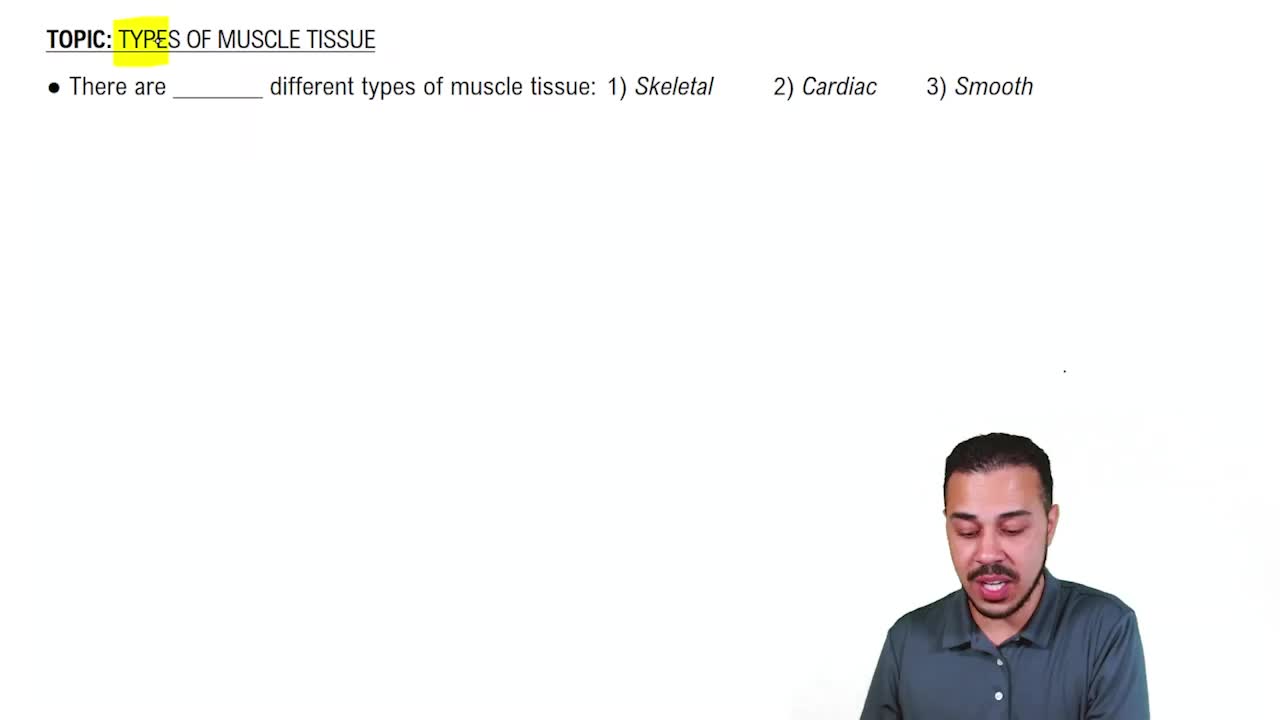
There are three main types of muscle tissue: smooth, cardiac, and skeletal. Smooth muscle is involuntary and found in walls of hollow organs; cardiac muscle is also involuntary and makes up the heart; skeletal muscle is voluntary and attached to bones. Each type has distinct structural and functional characteristics that influence how they contract and respond to stimuli.
Recommended video:
Guided course
00:36
3 Types of Muscle Tissue

Contraction Mechanisms

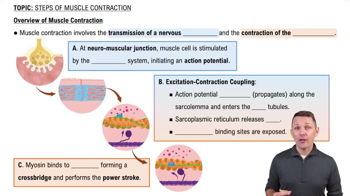
Muscle contraction is initiated by the interaction of actin and myosin filaments, regulated by calcium ions. In skeletal muscle, calcium binds to troponin, while in smooth muscle, it binds to calmodulin. Understanding these mechanisms is crucial for differentiating how each muscle type contracts and the role of calcium in these processes.
Recommended video:
Guided course
4:53
Overview of Muscle Contraction

Cellular Structures

Different muscle tissues have unique cellular structures that affect their function. For instance, cardiac muscle cells are connected by intercalated discs, allowing synchronized contraction, while smooth muscle cells attach to dense bodies. Skeletal muscle fibers are organized into sarcomeres, which are the basic contractile units, highlighting the structural diversity among muscle types.
Recommended video:
03:38
Introduction to Cellular Respiration