Ch. 10 Muscle Tissue and Physiology
Amerman- Human Anatomy & Physiology 3e
Amerman3rd EditionHuman Anatomy & PhysiologyISBN: 9780138247201, 9780138247928, 9780138201814Not the one you use?Change textbook
Chapter 10, Problem 19

List some of the functions of smooth muscle tissue.

Verified step by step guidance
1
Smooth muscle tissue is responsible for involuntary movements in the body, meaning it operates without conscious control. It is found in the walls of hollow organs such as the stomach, intestines, and blood vessels.
One key function of smooth muscle tissue is to regulate the diameter of blood vessels, which helps control blood pressure and blood flow throughout the body.
Smooth muscle in the gastrointestinal tract facilitates peristalsis, which is the wave-like contraction that moves food and waste through the digestive system.
In the respiratory system, smooth muscle tissue adjusts the diameter of airways, helping to regulate airflow into and out of the lungs.
Smooth muscle in the urinary and reproductive systems assists in functions such as the movement of urine through the ureters and the contraction of the uterus during childbirth.

Verified video answer for a similar problem:

This video solution was recommended by our tutors as helpful for the problem above.
Was this helpful?

Key Concepts

Here are the essential concepts you must grasp in order to answer the question correctly.

Smooth Muscle Tissue Structure

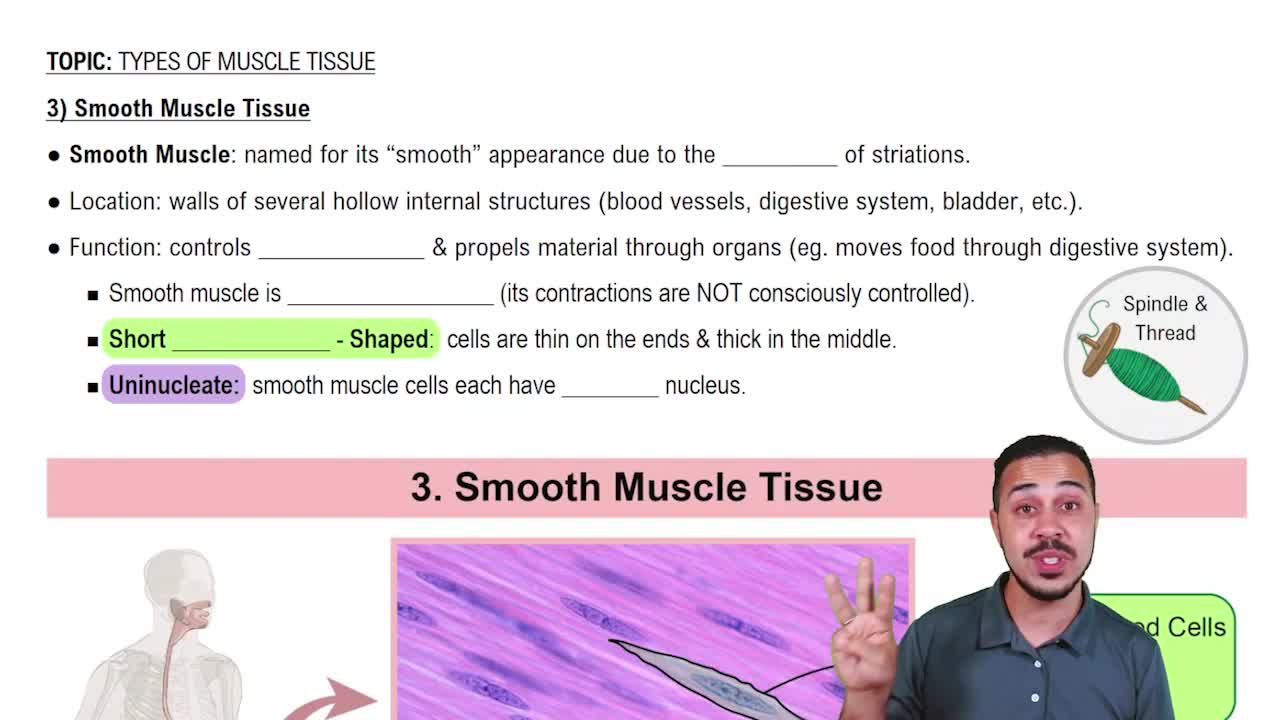
Smooth muscle tissue is composed of non-striated, spindle-shaped cells that are involuntary in nature. Unlike skeletal muscle, smooth muscle lacks the banded appearance due to the arrangement of actin and myosin filaments. This unique structure allows for sustained contractions and the ability to stretch without losing tension, making it essential for various bodily functions.
Recommended video:
Guided course
06:27
Smooth Muscle Tissue

Functions of Smooth Muscle

Smooth muscle tissue plays a critical role in various involuntary movements within the body. It is responsible for the contraction of hollow organs such as the intestines, blood vessels, and the bladder, facilitating processes like digestion, blood flow regulation, and urination. Its contractions are typically slow and sustained, allowing for efficient movement and control of internal processes.
Recommended video:
Guided course
06:27
Smooth Muscle Tissue

Regulation of Smooth Muscle Activity

The activity of smooth muscle is regulated by the autonomic nervous system and various hormones. Unlike skeletal muscle, which is controlled voluntarily, smooth muscle responds to stimuli such as stretch, chemical signals, and nerve impulses. This regulation allows smooth muscle to adapt to the needs of the body, such as increasing blood flow during exercise or contracting to move food through the digestive tract.
Recommended video:
Guided course
06:27
Smooth Muscle Tissue
Related Practice
Textbook Question

Which of the following best describes single-unit smooth muscle tissue?

a. The fibers function individually.

b. It is found in organs that require precise control of contraction.

c. It contains gap junctions that couple the fibers electrically.

d. The amount of tension produced varies with the number of muscle cells recruited.

1
views
Textbook Question

Which of the following factors is/are responsible for muscular fatigue?

a. Accumulation of chemicals, including calcium and phosphate ions & increased blood flow to the muscle

b. Decreased availability of oxygen

c. Psychological and environmental factors

d. Depletion of key metabolic fuels, such as creatine phosphate

1
views
Textbook Question

Mark the following statements as true for smooth muscle tissue, cardiac muscle tissue, and/or skeletal muscle tissue.          

a. _________ Actin attaches to dense bodies.          

b. _________ Cells are joined by intercalated discs.          

c. _________ The thick and thin filaments are arranged into sarcomeres.          

d. _________ The thick filaments contain myosin heads along their entire length.          

e. _________ The cells depolarize and contract as a unit.          

f. _________ Ca2+ binding to troponin is the initiating event of contraction.          

g. _________ Ca2+ binding to calmodulin is the initiating event of contraction.          

h. _________ The sarcolemma has a distinct motor end plate.

1
views
Textbook Question

Which of the following is not likely to result from endurance training alone?

a. Increase in oxidative enzymes in the muscle fiber

b. Increased numbers of mitochondria

c. Hypertrophy of the muscle fibers

d. Increase in blood supply to the muscle fibers

2
views
Textbook Question

What is thought to cause excess postexercise oxygen consumption?

2
views