Ch. 10 Muscle Tissue and Physiology
Amerman- Human Anatomy & Physiology 3e
Amerman3rd EditionHuman Anatomy & PhysiologyISBN: 9780138247201, 9780138247928, 9780138201814Not the one you use?Change textbook
Chapter 10, Problem 1

Which type of muscle fascicle pattern has an appearance similar to a feather?
a. Fusiform
b. Triangular
c. Pennate
d. Parallel

Verified step by step guidance
1
Understand the concept of muscle fascicle patterns: Muscle fascicle patterns refer to the arrangement of muscle fibers within a muscle. These patterns influence the muscle's function and range of motion.
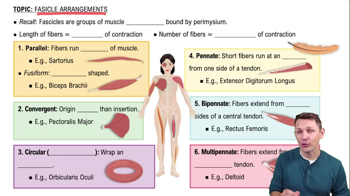
Learn about the different types of fascicle patterns: Fusiform muscles are spindle-shaped with a central belly, triangular muscles are fan-shaped, pennate muscles have fibers arranged at an angle to a central tendon resembling a feather, and parallel muscles have fibers running parallel to the muscle's long axis.
Focus on the pennate fascicle pattern: Pennate muscles are characterized by their feather-like appearance. The fibers are obliquely attached to a central tendon, which can be unipennate (fibers on one side of the tendon), bipennate (fibers on both sides of the tendon), or multipennate (multiple tendons with fibers attached at various angles).
Compare the options provided: Analyze the descriptions of fusiform, triangular, pennate, and parallel patterns to identify which one matches the feather-like appearance.
Conclude that the correct answer is the fascicle pattern resembling a feather, based on the anatomical description of pennate muscles.

Verified video answer for a similar problem:

This video solution was recommended by our tutors as helpful for the problem above.
Was this helpful?

Key Concepts

Here are the essential concepts you must grasp in order to answer the question correctly.

Muscle Fascicle Patterns

Muscle fascicle patterns refer to the arrangement of muscle fibers within a muscle. These patterns influence the muscle's strength, range of motion, and overall function. Understanding these arrangements is crucial for identifying how muscles contract and generate force.
Recommended video:
Guided course
8:11
Fascicle Arrangements

Pennate Muscle Arrangement

Pennate muscles are characterized by their feather-like structure, where the fascicles are arranged at an angle to the tendon. This arrangement allows for a greater number of fibers in a given area, enhancing the muscle's strength and force production, but often at the expense of range of motion.
Recommended video:
Guided course
8:11
Fascicle Arrangements

Types of Muscle Arrangements

There are several types of muscle arrangements, including fusiform, triangular, pennate, and parallel. Each type has distinct characteristics that affect muscle function. Recognizing these types is essential for understanding how muscles work in various movements and activities.
Recommended video:
Guided course
8:11
Fascicle Arrangements