Ch. 7 - Applications of Trigonometry and Vectors
Lial - Trigonometry 12th Edition
Lial12th EditionTrigonometryISBN: 9780136552161Not the one you use?Change textbook
Chapter 8, Problem 4

Use the law of sines to find the indicated part of each triangle ABC.


Find b if a = 165 m, A = 100.2°, B = 25.0°

Verified step by step guidance
1
Identify the known values from the problem: side \(a = 165\) m, angle \(A = 100.2^\circ\), and angle \(B = 25.0^\circ\).
Use the fact that the sum of angles in a triangle is \(180^\circ\) to find angle \(C\): calculate \(C = 180^\circ - A - B\).
Write down the Law of Sines formula: \(\frac{a}{\sin A} = \frac{b}{\sin B}\).
Rearrange the formula to solve for side \(b\): \(b = \frac{a \cdot \sin B}{\sin A}\).
Substitute the known values of \(a\), \(A\), and \(B\) into the formula and prepare to calculate \(b\).

Verified video answer for a similar problem:

This video solution was recommended by our tutors as helpful for the problem above.
Was this helpful?

Key Concepts

Here are the essential concepts you must grasp in order to answer the question correctly.

Law of Sines

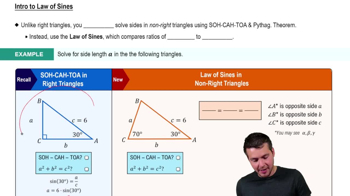
The Law of Sines relates the sides and angles of a triangle by stating that the ratio of the length of a side to the sine of its opposite angle is constant for all three sides. It is expressed as (a/sin A) = (b/sin B) = (c/sin C), and is especially useful for solving triangles when two angles and one side or two sides and a non-included angle are known.
Recommended video:
4:27
Intro to Law of Sines

Triangle Angle Sum Property

The sum of the interior angles in any triangle is always 180°. This property allows you to find the third angle when two angles are known, which is essential for applying the Law of Sines correctly, as all three angles must be known or determined to solve for unknown sides.
Recommended video:
4:47
Sum and Difference of Tangent

Solving for Unknown Sides

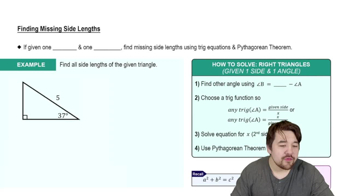
Once the Law of Sines is set up, solving for an unknown side involves rearranging the formula to isolate the desired side length. This requires substituting known values for sides and angles, calculating sine values, and performing algebraic manipulation to find the missing side accurately.
Recommended video:
4:18
Finding Missing Side Lengths
Related Practice
Textbook Question

In each figure, a line segment of length L is to be drawn from the given point to the positive x-axis in order to form a triangle. For what value(s) of L can we draw the following?

c. no triangle

<IMAGE>

3
views
Textbook Question

CONCEPT PREVIEW Refer to vectors a through h below. Make a copy or a sketch of each vector, and then draw a sketch to represent each of the following. For example, find a + e by placing a and e so that their initial points coincide. Then use the parallelogram rule to find the resultant, as shown in the figure on the right.


2c

Textbook Question

Determine the number of triangles ABC possible with the given parts.


a = 50, b = 26, A = 95°

1
views
Textbook Question

CONCEPT PREVIEW Refer to vectors a through h below. Make a copy or a sketch of each vector, and then draw a sketch to represent each of the following. For example, find a + e by placing a and e so that their initial points coincide. Then use the parallelogram rule to find the resultant, as shown in the figure on the right.


-b

Textbook Question

CONCEPT PREVIEW Assume a triangle ABC has standard labeling.


a. Determine whether SAA, ASA, SSA, SAS, or SSS is given.


b. Determine whether the law of sines or the law of cosines should be used to begin solving the triangle.


a, B, and C

Textbook Question

In each figure, a line segment of length L is to be drawn from the given point to the positive x-axis in order to form a triangle. For what value(s) of L can we draw the following?

b. exactly one triangle

<IMAGE>

3
views