Ch. 7 - Applications of Trigonometry and Vectors
Lial - Trigonometry 12th Edition
Lial12th EditionTrigonometryISBN: 9780136552161Not the one you use?Change textbook
Chapter 8, Problem 3b

In each figure, a line segment of length L is to be drawn from the given point to the positive x-axis in order to form a triangle. For what value(s) of L can we draw the following?
b. exactly one triangle
<IMAGE>

Verified step by step guidance
1
Identify the given point's coordinates and the angle(s) involved in forming the triangle with the positive x-axis and the segment of length \(L\).
Recall that the problem is about drawing a segment of length \(L\) from the point to the x-axis to form a triangle, so consider the geometric constraints: the segment must connect the point to some point on the positive x-axis.
Use the distance formula or trigonometric relationships to express the length \(L\) in terms of the coordinates of the point and the position on the x-axis where the segment meets it.
Analyze the conditions under which exactly one triangle can be formed. This typically happens when the segment length \(L\) equals the perpendicular distance from the point to the x-axis, or when the segment is tangent to a circle centered at the point with radius \(L\).
Set up an equation relating \(L\) to the coordinates and solve for the value(s) of \(L\) that yield exactly one solution, indicating exactly one triangle can be formed.

Verified video answer for a similar problem:

This video solution was recommended by our tutors as helpful for the problem above.
Was this helpful?

Key Concepts

Here are the essential concepts you must grasp in order to answer the question correctly.

Triangle Formation Conditions

Understanding when a triangle can be formed involves analyzing the lengths of sides and their relationships. Specifically, the triangle inequality theorem states that the sum of any two sides must be greater than the third side. This concept helps determine if a given segment length L can form one, two, or no triangles with the given points.
Recommended video:
6:08
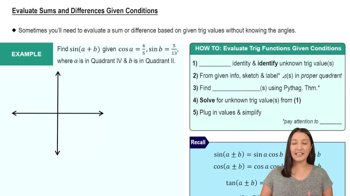
Evaluating Sums and Differences Given Conditions

Geometric Interpretation of Segment Lengths

Drawing a segment of length L from a point to the x-axis involves visualizing possible positions of the segment’s endpoint. The number of triangles formed depends on how many distinct points on the x-axis satisfy the length condition, which can be interpreted using circles or arcs centered at the given point with radius L.
Recommended video:
05:29
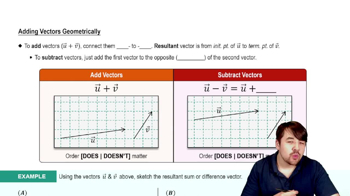
Adding Vectors Geometrically

Uniqueness of Triangle Formation

Exactly one triangle is formed when the segment length L corresponds to a unique intersection point on the x-axis. This typically occurs when the segment length equals the perpendicular distance from the point to the x-axis or when the segment is tangent to the circle representing all points at distance L, ensuring a single solution.
Recommended video:
5:35
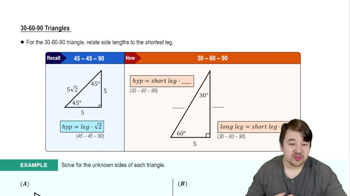
30-60-90 Triangles