
Textbook Question
In each figure, a line segment of length L is to be drawn from the given point to the positive x-axis in order to form a triangle. For what value(s) of L can we draw the following?
c. no triangle
<IMAGE>
3
views
 Verified step by step guidance
 5:35
5:35
 4:27
4:27 4:35
4:35In each figure, a line segment of length L is to be drawn from the given point to the positive x-axis in order to form a triangle. For what value(s) of L can we draw the following?
c. no triangle
<IMAGE>
Determine the number of triangles ABC possible with the given parts.
a = 50, b = 26, A = 95°
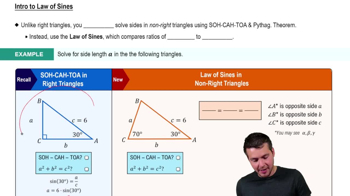
Use the law of sines to find the indicated part of each triangle ABC.
Find b if a = 165 m, A = 100.2°, B = 25.0°
CONCEPT PREVIEW Refer to vectors a through h below. Make a copy or a sketch of each vector, and then draw a sketch to represent each of the following. For example, find a + e by placing a and e so that their initial points coincide. Then use the parallelogram rule to find the resultant, as shown in the figure on the right.
-b
In each figure, a line segment of length L is to be drawn from the given point to the positive x-axis in order to form a triangle. For what value(s) of L can we draw the following?
a. two triangles
<IMAGE>
In each figure, a line segment of length L is to be drawn from the given point to the positive x-axis in order to form a triangle. For what value(s) of L can we draw the following?
b. exactly one triangle
<IMAGE>