Ch. 2 - Acute Angles and Right Triangles
Lial - Trigonometry 12th Edition
Lial12th EditionTrigonometryISBN: 9780136552161Not the one you use?Change textbook
Chapter 3, Problem 2.3.62

Use a calculator to determine whether each statement is true or false. A true statement may lead to results that differ in the last decimal place due to rounding error. cos(30° + 20°) = cos 30° + cos 20°

Verified step by step guidance
1
Recall the cosine addition formula: \(\cos(A + B) = \cos A \cos B - \sin A \sin B\).
Apply the formula to the left side of the equation: \(\cos(30^\circ + 20^\circ) = \cos 30^\circ \cos 20^\circ - \sin 30^\circ \sin 20^\circ\).
Calculate the right side of the equation as given: \(\cos 30^\circ + \cos 20^\circ\).
Use a calculator to find the numerical values of both sides: compute \(\cos 30^\circ \cos 20^\circ - \sin 30^\circ \sin 20^\circ\) and \(\cos 30^\circ + \cos 20^\circ\) separately.
Compare the two results to determine if the original statement is true or false, keeping in mind that small differences in the last decimal place may be due to rounding errors.

Verified video answer for a similar problem:

This video solution was recommended by our tutors as helpful for the problem above.
Video duration:
2m
Was this helpful?

Key Concepts

Here are the essential concepts you must grasp in order to answer the question correctly.

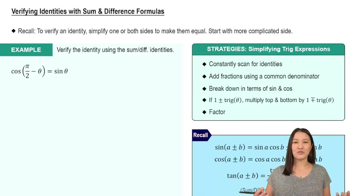
Cosine of a Sum Formula

The cosine of the sum of two angles is given by cos(A + B) = cos A cos B - sin A sin B. This identity is fundamental for evaluating expressions involving the cosine of angle sums and helps verify if an equation involving cos(30° + 20°) is true.
Recommended video:
2:25
Verifying Identities with Sum and Difference Formulas

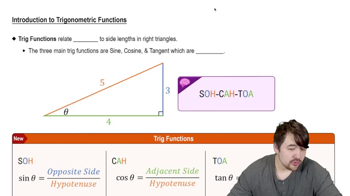
Properties of Trigonometric Functions

Trigonometric functions like cosine are nonlinear and do not distribute over addition, meaning cos(A + B) is not equal to cos A + cos B. Understanding this property is essential to avoid common misconceptions when comparing trigonometric expressions.
Recommended video:
6:04
Introduction to Trigonometric Functions

Rounding Errors in Calculator Computations

Calculators approximate trigonometric values, which can cause minor differences in the last decimal places. Recognizing that small discrepancies may arise from rounding helps in correctly interpreting the truth value of trigonometric statements.
Recommended video:
05:21
Computing the Cross Product
Related Practice
Textbook Question

Use a calculator to approximate the value of each expression. Give answers to six decimal places. In Exercises 21–28, simplify the expression before using the calculator. See Example 1.

1/csc(90°-51°)

2
views

Textbook Question

Solve each problem. See Examples 1 and 2. Distance between Two Ships A ship leaves its home port and sails on a bearing of S 61°50'. Another ship leaves the same port at the same time and sails on a bearing of N 28°10'E. If the first ship sails at 24.0 mph and the second sails at 28.0 mph, find the distance between the two ships after 4 hr.

1
views
Textbook Question

Concept Check The two methods of expressing bearing can be interpreted using a rectangular coordinate system. Suppose that an observer for a radar station is located at the origin of a coordinate system. Find the bearing of an airplane located at each point. Express the bearing using both methods. (-3, -3)

Textbook Question

Use a calculator to approximate the value of each expression. Give answers to six decimal places. In Exercises 21–28, simplify the expression before using the calculator. See Example 1.

cos 41° 24'

1
views
Textbook Question

Use a calculator to determine whether each statement is true or false. A true statement may lead to results that differ in the last decimal place due to rounding error. tan² 72°25' + 1 = sec² 72°25'

1
views
Textbook Question

Solve each problem. See Examples 3 and 4. Height of an Antenna A scanner antenna is on top of the center of a house. The angle of elevation from a point 28.0 m from the center of the house to the top of the antenna is 27°10', and the angle of elevation to the bottom of the antenna is 18°10'. Find the height of the antenna.