Ch. 2 - Acute Angles and Right Triangles
Lial - Trigonometry 12th Edition
Lial12th EditionTrigonometryISBN: 9780136552161Not the one you use?Change textbook
Chapter 3, Problem 2.3.27

Use a calculator to approximate the value of each expression. Give answers to six decimal places. In Exercises 21–28, simplify the expression before using the calculator. See Example 1.
1/csc(90°-51°)

Verified step by step guidance
1
Recognize that the expression is \( \frac{1}{\csc(90^\circ - 51^\circ)} \). The first step is to simplify the angle inside the cosecant function: calculate \( 90^\circ - 51^\circ \).
Recall the co-function identity for cosecant: \( \csc(90^\circ - \theta) = \sec(\theta) \). Use this identity to rewrite \( \csc(90^\circ - 51^\circ) \) as \( \sec(51^\circ) \).
Substitute the simplified expression back into the original fraction: \( \frac{1}{\sec(51^\circ)} \).
Recall that \( \sec(\theta) = \frac{1}{\cos(\theta)} \), so \( \frac{1}{\sec(51^\circ)} = \cos(51^\circ) \).
Use a calculator to find \( \cos(51^\circ) \) and round the result to six decimal places.

Verified video answer for a similar problem:

This video solution was recommended by our tutors as helpful for the problem above.
Video duration:
2m
Was this helpful?

Key Concepts

Here are the essential concepts you must grasp in order to answer the question correctly.

Reciprocal Trigonometric Functions

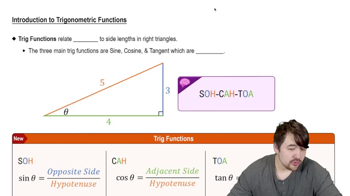
The cosecant function (csc) is the reciprocal of the sine function, meaning csc(θ) = 1/sin(θ). Understanding this relationship allows simplification of expressions involving csc by converting them into sine functions, which are often easier to evaluate.
Recommended video:
6:04
Introduction to Trigonometric Functions

Co-Function Identity

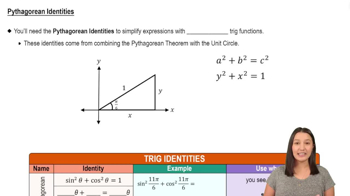
The co-function identity states that csc(90° - θ) = sec(θ), linking complementary angles in trigonometry. This identity helps simplify expressions by transforming csc of a complementary angle into sec, which can then be evaluated or further simplified.
Recommended video:
6:25
Pythagorean Identities

Using a Calculator for Trigonometric Values

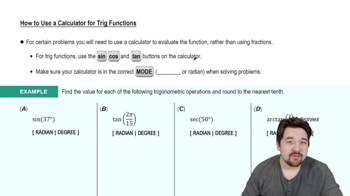
Calculators can approximate trigonometric values to a desired decimal precision. After simplifying the expression, input the angle in degrees or radians as required, and round the result to six decimal places for accuracy and consistency.
Recommended video:
4:45
How to Use a Calculator for Trig Functions
Related Practice
Textbook Question

Solve each problem. See Examples 1 and 2. Distance between Two Ships A ship leaves its home port and sails on a bearing of S 61°50'. Another ship leaves the same port at the same time and sails on a bearing of N 28°10'E. If the first ship sails at 24.0 mph and the second sails at 28.0 mph, find the distance between the two ships after 4 hr.

1
views
Textbook Question

Use a calculator to approximate the value of each expression. Give answers to six decimal places. In Exercises 21–28, simplify the expression before using the calculator. See Example 1.

cos 41° 24'

1
views
Textbook Question

Use a calculator to determine whether each statement is true or false. A true statement may lead to results that differ in the last decimal place due to rounding error. cos(30° + 20°) = cos 30° + cos 20°

1
views
Textbook Question

Use a calculator to determine whether each statement is true or false. A true statement may lead to results that differ in the last decimal place due to rounding error. tan² 72°25' + 1 = sec² 72°25'

1
views
Textbook Question

Solve each problem. See Examples 3 and 4. Height of an Antenna A scanner antenna is on top of the center of a house. The angle of elevation from a point 28.0 m from the center of the house to the top of the antenna is 27°10', and the angle of elevation to the bottom of the antenna is 18°10'. Find the height of the antenna.

Textbook Question

Find two angles in the interval [0°, 360°) that satisfy each of the following. Round answers to the nearest degree. cos θ = 0.10452846

6
views