In Exercises 57–70, find a positive angle less than or that is coterminal with the given angle. -𝜋/40
Ch. 1 - Angles and the Trigonometric Functions

Chapter 1, Problem 1
In Exercises 1–6, the measure of an angle is given. Classify the angle as acute, right, obtuse, or straight. 135°
Verified step by step guidance1
Recall the definitions of angle classifications: an acute angle is between 0° and 90°, a right angle is exactly 90°, an obtuse angle is between 90° and 180°, and a straight angle is exactly 180°.
Look at the given angle measure, which is 135°.
Compare 135° to the ranges defined: since 135° is greater than 90° but less than 180°, it falls into the obtuse angle category.
Therefore, classify the angle 135° as an obtuse angle based on the comparison.
Summarize: 135° is an obtuse angle because it lies between 90° and 180°.

Verified video answer for a similar problem:
This video solution was recommended by our tutors as helpful for the problem above.
Video duration:
1mWas this helpful?
Key Concepts
Here are the essential concepts you must grasp in order to answer the question correctly.
Angle Measurement in Degrees
Angles are measured in degrees, representing the amount of rotation from one ray to another around a common vertex. A full circle is 360°, a straight angle is 180°, and smaller angles are fractions of this rotation.
Recommended video:
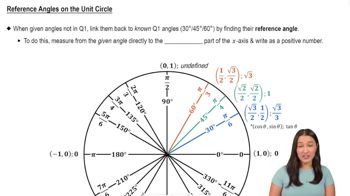
Reference Angles on the Unit Circle
Classification of Angles
Angles are classified based on their measure: acute angles are less than 90°, right angles are exactly 90°, obtuse angles are greater than 90° but less than 180°, and straight angles are exactly 180°.
Recommended video:
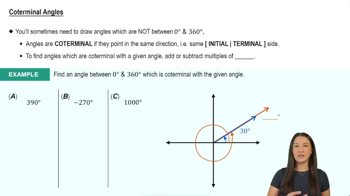
Coterminal Angles
Comparing Angle Measures
To classify an angle, compare its degree measure to the standard angle categories. For example, 135° is greater than 90° but less than 180°, so it is classified as an obtuse angle.
Recommended video:
Reference Angles on the Unit Circle
Related Practice
Textbook Question
2
views
Textbook Question
In Exercises 35–60, find the reference angle for each angle. 5.5
1
views
Textbook Question
In Exercises 1–8, use the Pythagorean Theorem to find the length of the missing side of each right triangle. Then find the value of each of the six trigonometric functions of θ.
9
views
Textbook Question
In Exercises 61–86, use reference angles to find the exact value of each expression. Do not use a calculator. tan(9𝜋/2)
1
views
Textbook Question
In Exercises 75–78, find the area of the sector of a circle of radius r formed by a central angle θ. Express area in terms of π. Then round your answer to two decimal places. Radius, r: 10 meters Central Angle, θ: θ = 18°
Textbook Question
In Exercises 61–86, use reference angles to find the exact value of each expression. Do not use a calculator. cot(7𝜋/4)
1
views