Ch. 1 - Angles and the Trigonometric Functions
Blitzer - Trigonometry 3rd Edition
Blitzer3rd EditionTrigonometryISBN: 9780137316601Not the one you use?Change textbook
Chapter 1, Problem 1.1.68

In Exercises 57–70, find a positive angle less than or that is coterminal with the given angle. -πœ‹/40

Verified step by step guidance
1
Understand that two angles are coterminal if they differ by an integer multiple of \(2\pi\). This means we can add or subtract \(2\pi\) to the given angle to find coterminal angles.
The given angle is \(-\frac{\pi}{40}\). Since it is negative, to find a positive coterminal angle less than or equal to \(2\pi\), add \(2\pi\) to it.
Write the expression for the coterminal angle: \(-\frac{\pi}{40} + 2\pi\).
To add these, express \(2\pi\) with a denominator of 40: \(2\pi = \frac{80\pi}{40}\). So the sum becomes \(-\frac{\pi}{40} + \frac{80\pi}{40} = \frac{79\pi}{40}\).
Verify that \(\frac{79\pi}{40}\) is positive and less than or equal to \(2\pi\) to confirm it is the desired coterminal angle.

Verified video answer for a similar problem:

This video solution was recommended by our tutors as helpful for the problem above.
Video duration:
1m
Was this helpful?

Key Concepts

Here are the essential concepts you must grasp in order to answer the question correctly.

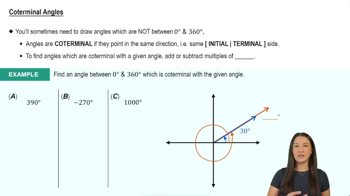
Coterminal Angles

Coterminal angles are angles that share the same initial and terminal sides but differ by full rotations of 2Ο€ radians. To find a coterminal angle, you add or subtract multiples of 2Ο€ until the angle lies within the desired range, such as between 0 and 2Ο€.
Recommended video:
04:46
Coterminal Angles

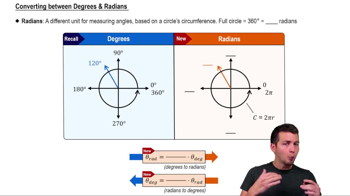
Angle Measurement in Radians

Angles can be measured in radians, where 2Ο€ radians equal 360 degrees. Understanding radian measure is essential for working with trigonometric functions and converting between degrees and radians when necessary.
Recommended video:
5:04
Converting between Degrees & Radians

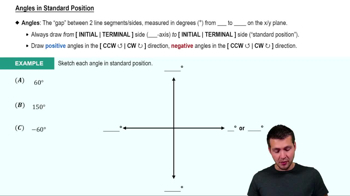
Positive Angle Determination

Finding a positive angle less than or equal to 2Ο€ involves adjusting the given angle by adding 2Ο€ repeatedly if it is negative. This ensures the angle is expressed within the standard interval for trigonometric analysis.
Recommended video:
05:50
Drawing Angles in Standard Position