Ch. 1 - Angles and the Trigonometric Functions
Blitzer - Trigonometry 3rd Edition
Blitzer3rd EditionTrigonometryISBN: 9780137316601Not the one you use?Change textbook
Chapter 1, Problem 1.1.75

In Exercises 75–78, find the area of the sector of a circle of radius r formed by a central angle θ. Express area in terms of π. Then round your answer to two decimal places. Radius, r: 10 meters Central Angle, θ: θ = 18°

Verified step by step guidance
1
Recall the formula for the area of a sector of a circle: \(\text{Area} = \frac{\theta}{360^\circ} \times \pi r^2\), where \(\theta\) is the central angle in degrees and \(r\) is the radius of the circle.
Substitute the given values into the formula: \(r = 10\) meters and \(\theta = 18^\circ\), so the area becomes \(\frac{18}{360} \times \pi \times 10^2\).
Simplify the fraction \(\frac{18}{360}\) to its lowest terms to make calculations easier.
Calculate the expression \(\pi \times 10^2\) which represents the area of the full circle, then multiply by the simplified fraction to find the sector area in terms of \(\pi\).
Finally, use the approximate value of \(\pi \approx 3.1416\) to compute the numerical value of the sector area and round your answer to two decimal places.

Verified video answer for a similar problem:

This video solution was recommended by our tutors as helpful for the problem above.
Video duration:
3m
Was this helpful?

Key Concepts

Here are the essential concepts you must grasp in order to answer the question correctly.

Area of a Sector

The area of a sector of a circle is the portion of the circle's area enclosed by two radii and the arc between them. It is calculated as (θ/360) × π × r² when θ is in degrees, where r is the radius and θ is the central angle.
Recommended video:
4:02
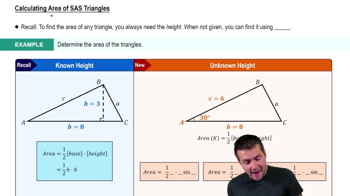
Calculating Area of SAS Triangles

Central Angle in Degrees

The central angle θ is the angle formed at the center of the circle by two radii. When given in degrees, it must be used directly in the sector area formula as a fraction of 360°, representing the full circle.
Recommended video:
04:46
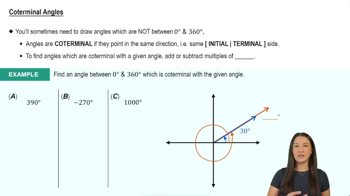
Coterminal Angles

Rounding Numerical Results

After calculating the exact area in terms of π, numerical approximation involves substituting π ≈ 3.1416 and rounding the final answer to the specified decimal places, here two decimals, to provide a practical and understandable result.
Recommended video:
04:33
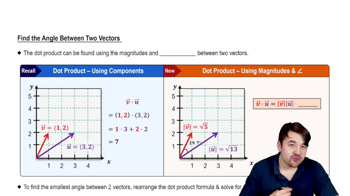
Find the Angle Between Vectors