Ch. 7 - Applications of Trigonometry and Vectors
Lial - Trigonometry 12th Edition
Lial12th EditionTrigonometryISBN: 9780136552161Not the one you use?Change textbook
Chapter 8, Problem 36

Radio direction finders are placed at points A and B, which are 3.46 mi apart on an east-west line, with A west of B. From A the bearing of a certain radio transmitter is 47.7°, and from B the bearing is 302.5°. Find the distance of the transmitter from A.

Verified step by step guidance
1
Draw a diagram to visualize the problem: place points A and B on a horizontal east-west line with A to the west and B to the east, 3.46 miles apart. Mark the bearings from A and B to the transmitter as given.
Convert the bearings into angles relative to the east-west line. From A, the bearing 47.7° is measured clockwise from north, so find the angle between the line AB and the line from A to the transmitter. Similarly, convert the bearing from B (302.5°) into an angle relative to the line AB.
Use the angles found to determine the directions of the lines from A and B to the transmitter. This will allow you to form a triangle with vertices at A, B, and the transmitter.
Apply the Law of Sines to the triangle formed by points A, B, and the transmitter. You know the side AB = 3.46 miles and the two angles at A and B (found from the bearings). Use the Law of Sines formula: \(\frac{a}{\sin A} = \frac{b}{\sin B} = \frac{c}{\sin C}\), where sides are opposite their respective angles.
Solve for the side opposite the angle at B, which corresponds to the distance from A to the transmitter. This will give you the required distance without calculating the final numeric value.

Verified video answer for a similar problem:

This video solution was recommended by our tutors as helpful for the problem above.
Was this helpful?

Key Concepts

Here are the essential concepts you must grasp in order to answer the question correctly.

Bearings and Angle Measurement

Bearings are angles measured clockwise from the north direction to the line connecting the observer to the object. Understanding how to interpret and convert bearings into standard angles or directions is essential for locating positions on a plane, especially in navigation and surveying problems.
Recommended video:
5:31
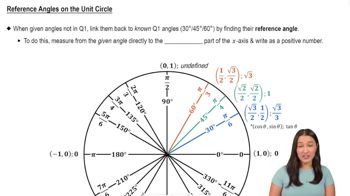
Reference Angles on the Unit Circle

Triangle Formation and Law of Sines

The positions of points A, B, and the transmitter form a triangle. The Law of Sines relates the sides and angles of a triangle, allowing calculation of unknown distances or angles when some are known. This law is crucial for solving the distance from A to the transmitter using the given bearings.
Recommended video:
4:27
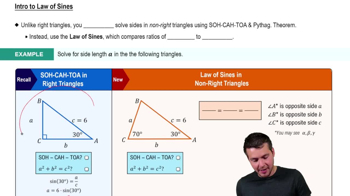
Intro to Law of Sines

Coordinate Geometry and Vector Representation

Representing points and directions using coordinate geometry helps visualize the problem. By placing A and B on an east-west axis and using bearings to determine directions, one can translate the problem into a coordinate system, facilitating the use of trigonometric relationships to find distances.
Recommended video:
05:29
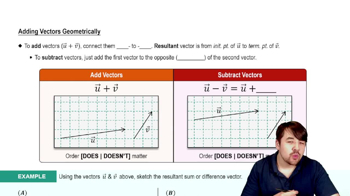
Adding Vectors Geometrically