Ch. 1 - Trigonometric Functions
Lial - Trigonometry 12th Edition
Lial12th EditionTrigonometryISBN: 9780136552161Not the one you use?Change textbook
Chapter 2, Problem 22

Find the measure of (a) the complement and (b) the supplement of an angle with the given measure. See Examples 1 and 3. 50° 40' 50"

Verified step by step guidance
1
Understand the definitions: The complement of an angle is what, when added to the angle, equals 90 degrees, and the supplement of an angle is what, when added to the angle, equals 180 degrees.
Convert the given angle 50° 40' 50" into a consistent format if needed, but since the problem is in degrees, minutes, and seconds, we can work directly with these units.
To find the complement, subtract the given angle from 90° 0' 0" using the subtraction of degrees, minutes, and seconds carefully:
\[ \text{Complement} = 90^\circ 0' 0'' - 50^\circ 40' 50'' \]
To find the supplement, subtract the given angle from 180° 0' 0" similarly:
\[ \text{Supplement} = 180^\circ 0' 0'' - 50^\circ 40' 50'' \]
Perform the subtraction step-by-step, borrowing minutes and seconds as necessary to handle the subtraction of minutes and seconds correctly.

Verified video answer for a similar problem:

This video solution was recommended by our tutors as helpful for the problem above.
Video duration:
4m
Was this helpful?

Key Concepts

Here are the essential concepts you must grasp in order to answer the question correctly.

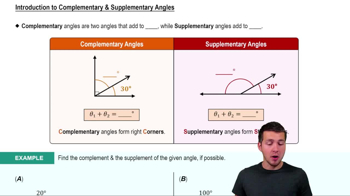
Complementary Angles

Complementary angles are two angles whose measures add up to 90 degrees. To find the complement of a given angle, subtract the angle's measure from 90°. This concept is essential for problems involving right angles and angle pairs.
Recommended video:
3:35
Intro to Complementary & Supplementary Angles

Supplementary Angles

Supplementary angles are two angles whose measures add up to 180 degrees. To find the supplement of a given angle, subtract the angle's measure from 180°. This concept is important when dealing with straight lines and linear pairs of angles.
Recommended video:
3:35
Intro to Complementary & Supplementary Angles

Angle Measurement in Degrees, Minutes, and Seconds

Angles can be measured in degrees (°), minutes ('), and seconds ("). One degree equals 60 minutes, and one minute equals 60 seconds. Properly converting and subtracting these units is crucial when calculating complements and supplements of angles given in this format.
Recommended video:
5:31
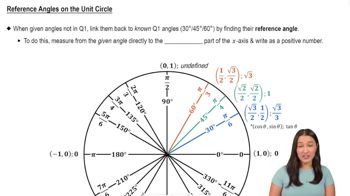
Reference Angles on the Unit Circle