Ch. 1 - Trigonometric Functions
Lial - Trigonometry 12th Edition
Lial12th EditionTrigonometryISBN: 9780136552161Not the one you use?Change textbook
Chapter 2, Problem 21

In each figure, there are two similar triangles. Find the unknown measurement. Give any approximation to the nearest tenth.

Verified step by step guidance
1
Identify the corresponding sides of the two similar triangles. Since the triangles are similar, their corresponding sides are proportional.
Set up a proportion equation using the lengths of the known sides and the unknown side. For example, if the sides correspond as \(a\) to \(a'\), \(b\) to \(b'\), and \(c\) to \(c'\), then the ratio \(\frac{a}{a'} = \frac{b}{b'} = \frac{c}{c'}\) holds.
Choose the pair of corresponding sides where you know three of the lengths (two from one triangle and one from the other) to form an equation with the unknown side.
Solve the proportion equation for the unknown side by cross-multiplying and isolating the variable.
Once you find the value of the unknown side, round your answer to the nearest tenth as requested.

Verified video answer for a similar problem:

This video solution was recommended by our tutors as helpful for the problem above.
Video duration:
3m
Was this helpful?

Key Concepts

Here are the essential concepts you must grasp in order to answer the question correctly.

Similarity of Triangles

Two triangles are similar if their corresponding angles are equal and their corresponding sides are proportional. This means one triangle is a scaled version of the other, allowing us to set up ratios between corresponding sides to find unknown lengths.
Recommended video:
5:35
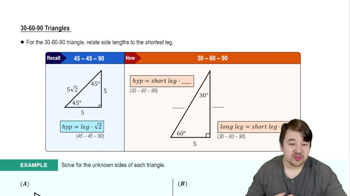
30-60-90 Triangles

Proportionality of Corresponding Sides

In similar triangles, the ratios of the lengths of corresponding sides are equal. This property enables solving for unknown side lengths by setting up and solving proportion equations based on known side measurements.
Recommended video:
4:18
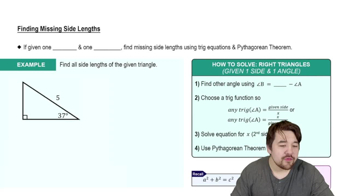
Finding Missing Side Lengths

Rounding and Approximation

When calculating unknown measurements, the result may be an irrational or decimal number. Rounding to the nearest tenth means adjusting the value to one decimal place, which simplifies the answer while maintaining reasonable accuracy.
Recommended video:
4:45
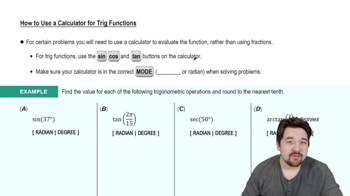
How to Use a Calculator for Trig Functions