Find the measure of each marked angle. In Exercises 19–22, m and n are parallel. See Examples 1 and 2 .
Ch. 1 - Trigonometric Functions
Chapter 2, Problem 20
Find the unknown side lengths in each pair of similar triangles.
Verified step by step guidance1
Identify the pairs of corresponding sides in the similar triangles. Since the triangles are similar, their corresponding angles are equal, and their corresponding sides are proportional.
Set up a proportion between the lengths of corresponding sides. For example, if side \(a\) in the first triangle corresponds to side \(a'\) in the second triangle, and side \(b\) corresponds to side \(b'\), then the ratio \(\frac{a}{a'} = \frac{b}{b'}\) holds.
Use the known side lengths to write an equation involving the unknown side length. Substitute the known values into the proportion to create an equation.
Solve the equation for the unknown side length by cross-multiplying and isolating the variable.
Check your solution by verifying that the ratios of all pairs of corresponding sides are equal, confirming the triangles remain similar.

Verified video answer for a similar problem:
This video solution was recommended by our tutors as helpful for the problem above.
Video duration:
5mWas this helpful?
Key Concepts
Here are the essential concepts you must grasp in order to answer the question correctly.
Similarity of Triangles
Two triangles are similar if their corresponding angles are equal and their corresponding sides are in proportion. This means the shape is the same but the size may differ, allowing us to relate side lengths using scale factors.
Recommended video:
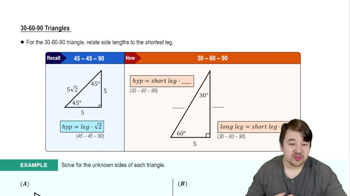
30-60-90 Triangles
Ratio of Corresponding Sides
In similar triangles, the lengths of corresponding sides are proportional. This ratio, or scale factor, can be used to find unknown side lengths by setting up and solving proportions between known and unknown sides.
Recommended video:
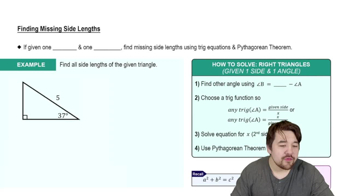
Finding Missing Side Lengths
Setting Up and Solving Proportions
To find unknown sides, write a proportion equating the ratio of known sides in one triangle to the corresponding sides in the other. Solving this proportion involves cross-multiplication and algebraic manipulation to isolate and calculate the unknown length.
Recommended video:
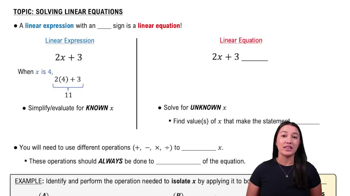
Solving Linear Equations
Related Practice
Textbook Question
Textbook Question
In each figure, there are two similar triangles. Find the unknown measurement. Give any approximation to the nearest tenth.
1
views
Textbook Question
Find the measure of (a) the complement and (b) the supplement of an angle with the given measure. See Examples 1 and 3. 14° 20'
1
views
Textbook Question
Use the appropriate reciprocal identity to find each function value. Rationalize denominators when applicable. See Example 1.
sin θ , given that csc θ = √24/3
5
views
Textbook Question
Length of a Shadow If a tree 20 ft tall casts a shadow 8 ft long, how long would the shadow of a 30-ft tree be at the same time and place?
Textbook Question
Find the measure of (a) the complement and (b) the supplement of an angle with the given measure. See Examples 1 and 3. 50° 40' 50"
1
views