In Exercises 1–8, parametric equations and a value for the parameter t are given. Find the coordinates of the point on the plane curve described by the parametric equations corresponding to the given value of t. x = (60 cos 30°)t, y = 5 + (60 sin 30°)t − 16t²; t = 2
Ch. 5 - Complex Numbers, Polar Coordinates and Parametric Equations

All textbooks
Blitzer 3rd Edition
Ch. 5 - Complex Numbers, Polar Coordinates and Parametric Equations
Problem 9
Blitzer 3rd Edition
Ch. 5 - Complex Numbers, Polar Coordinates and Parametric Equations
Problem 9Chapter 5, Problem 9
Plot each complex number and find its absolute value. z = −3 + 4i
Verified step by step guidance1
Identify the complex number given: \(z = -3 + 4i\), where the real part is \(-3\) and the imaginary part is \(4\).
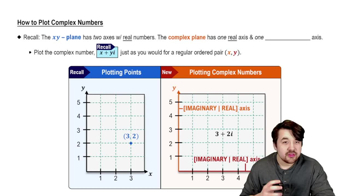
Plot the complex number on the complex plane by marking the point with coordinates \(( -3, 4 )\), where the x-axis represents the real part and the y-axis represents the imaginary part.
Recall that the absolute value (or modulus) of a complex number \(z = a + bi\) is given by the formula \(|z| = \sqrt{a^2 + b^2}\).
Substitute the values of \(a = -3\) and \(b = 4\) into the formula to get \(|z| = \sqrt{(-3)^2 + 4^2}\).
Simplify the expression under the square root to find the absolute value, which represents the distance of the point from the origin in the complex plane.

Verified video answer for a similar problem:
This video solution was recommended by our tutors as helpful for the problem above.
Video duration:
2mWas this helpful?
Key Concepts
Here are the essential concepts you must grasp in order to answer the question correctly.
Complex Numbers and the Complex Plane
A complex number is expressed as z = a + bi, where a is the real part and b is the imaginary part. It can be represented as a point (a, b) on the complex plane, with the horizontal axis for the real part and the vertical axis for the imaginary part.
Recommended video:
Dividing Complex Numbers
Plotting Complex Numbers
To plot a complex number, locate its real part on the x-axis and its imaginary part on the y-axis. For z = -3 + 4i, plot the point at (-3, 4) in the complex plane, which visually represents the number.
Recommended video:
How To Plot Complex Numbers
Absolute Value (Modulus) of a Complex Number
The absolute value or modulus of a complex number z = a + bi is the distance from the origin to the point (a, b) on the complex plane. It is calculated as |z| = √(a² + b²), representing the magnitude of the complex number.
Recommended video:
Dividing Complex Numbers
Related Practice
Textbook Question
Textbook Question
Perform the indicated operations and write the result in standard form. √−32 − √−18
1
views
Textbook Question
Test for symmetry with respect to a. the polar axis. b. the line θ = π/2. c. the pole. r = 4 + 3 cos θ
Textbook Question
In Exercises 1–8, add or subtract as indicated and write the result in standard form. 8i − (14 − 9i)
1
views
Textbook Question
Indicate if the point with the given polar coordinates is represented by A, B, C, or D on the graph. (−3, −3π/4)
Textbook Question
In Exercises 9–20, find each product and write the result in standard form. −3i(7i − 5)