Ch. 5 - Complex Numbers, Polar Coordinates and Parametric Equations
Blitzer - Trigonometry 3rd Edition
Blitzer3rd EditionTrigonometryISBN: 9780137316601Not the one you use?Change textbook
Chapter 5, Problem 7

In Exercises 1–8, add or subtract as indicated and write the result in standard form. 8i − (14 − 9i)

Verified step by step guidance
1
Identify the expression to simplify: \(8i - (14 - 9i)\).
Distribute the negative sign across the terms inside the parentheses: \(8i - 14 + 9i\).
Group the real parts and the imaginary parts separately: \((-14) + (8i + 9i)\).
Combine like terms: the real part remains \(-14\), and the imaginary parts add up to \$17i$.
Write the final expression in standard form \(a + bi\): \(-14 + 17i\).

Verified video answer for a similar problem:

This video solution was recommended by our tutors as helpful for the problem above.
Video duration:
2m
Was this helpful?

Key Concepts

Here are the essential concepts you must grasp in order to answer the question correctly.

Complex Numbers and Standard Form

Complex numbers are expressed in the form a + bi, where a is the real part and b is the imaginary part. The standard form ensures clarity in addition, subtraction, and other operations by separating real and imaginary components.
Recommended video:
04:47
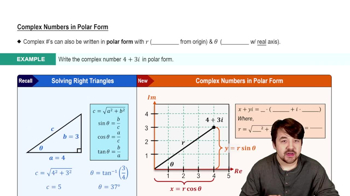
Complex Numbers In Polar Form

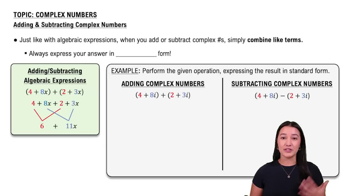
Addition and Subtraction of Complex Numbers

To add or subtract complex numbers, combine their real parts and imaginary parts separately. For example, (a + bi) - (c + di) = (a - c) + (b - d)i, maintaining the standard form.
Recommended video:
3:18
Adding and Subtracting Complex Numbers

Distributive Property in Algebra

The distributive property allows you to remove parentheses by multiplying a term outside the parentheses by each term inside. For example, a(b - c) = ab - ac, which is essential when subtracting complex numbers with parentheses.
Recommended video:
04:12
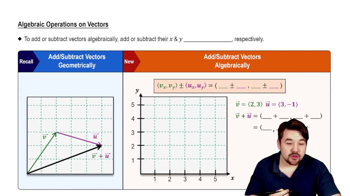
Algebraic Operations on Vectors