Textbook Question
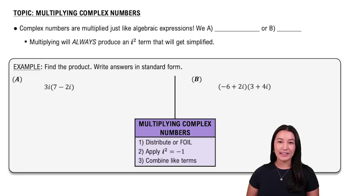
Perform the indicated operations and write the result in standard form. (−2 + √−100)²

 Blitzer 3rd EditionCh. 5 - Complex Numbers, Polar Coordinates and Parametric EquationsProblem 9
 Verified step by step guidance
 06:01
06:01
 5:02
5:02 04:47
04:47Perform the indicated operations and write the result in standard form. (−2 + √−100)²
In Exercises 1–8, parametric equations and a value for the parameter t are given. Find the coordinates of the point on the plane curve described by the parametric equations corresponding to the given value of t. x = (60 cos 30°)t, y = 5 + (60 sin 30°)t − 16t²; t = 2
Perform the indicated operations and write the result in standard form. √−32 − √−18
Test for symmetry with respect to a. the polar axis. b. the line θ = π/2. c. the pole. r = 4 + 3 cos θ
Indicate if the point with the given polar coordinates is represented by A, B, C, or D on the graph. (−3, −3π/4)
Plot each complex number and find its absolute value. z = −3 + 4i