Ch. 7 - Estimating Parameters and Determining Sample Sizes
Triola - Elementary Statistics 14th Edition
Triola14th EditionElementary StatisticsISBN: 9780137366446Not the one you use?Change textbook
Chapter 7, Problem 7.r.1b

Bachelor’s Degree in Four Years In a study of government financial aid for college students, it becomes necessary to estimate the percentage of full-time college students who earn a bachelor’s degree in four years or less. Find the sample size needed to estimate that percentage. Use a 0.1 margin of error, and use a confidence level of 95%.


b. Assume that prior studies have shown that about 40% of full-time students earn bachelor’s degrees in four years or less.

Verified step by step guidance
1
Step 1: Identify the formula for determining the required sample size for estimating a population proportion. The formula is: n = (Z^2 * p * (1 - p)) / E^2, where n is the sample size, Z is the z-score corresponding to the confidence level, p is the estimated population proportion, and E is the margin of error.
Step 2: Determine the values for the variables in the formula. From the problem, the confidence level is 95%, so the z-score (Z) corresponding to this confidence level is approximately 1.96. The estimated population proportion (p) is 0.40, and the margin of error (E) is 0.1.
Step 3: Substitute the values into the formula. Replace Z with 1.96, p with 0.40, and E with 0.1 in the formula: n = (1.96^2 * 0.40 * (1 - 0.40)) / 0.1^2.
Step 4: Simplify the numerator of the formula. Calculate Z^2 (1.96^2), p * (1 - p) (0.40 * 0.60), and multiply these values together.
Step 5: Divide the result from Step 4 by the square of the margin of error (E^2 = 0.1^2). This will give you the required sample size (n). Round up to the nearest whole number, as sample size must be an integer.

Verified video answer for a similar problem:

This video solution was recommended by our tutors as helpful for the problem above.
Video duration:
2m
Was this helpful?

Key Concepts

Here are the essential concepts you must grasp in order to answer the question correctly.

Sample Size Determination

Sample size determination is a statistical process used to calculate the number of observations or replicates needed to ensure that a study's results are reliable and valid. It involves considering factors such as the desired margin of error, confidence level, and the estimated proportion of the population. In this case, the goal is to estimate the percentage of students earning degrees within a specific timeframe, which requires an appropriate sample size to achieve accurate results.
Recommended video:
Guided course
06:14
Coefficient of Determination

Margin of Error

The margin of error is a statistic that expresses the amount of random sampling error in a survey's results. It indicates the range within which the true population parameter is expected to fall, given a certain confidence level. A smaller margin of error requires a larger sample size, as it reflects a higher precision in estimating the population proportion—in this scenario, the percentage of students graduating in four years.
Recommended video:
04:08
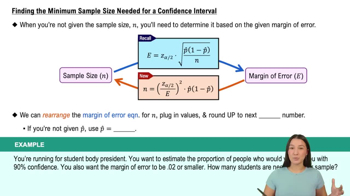
Finding the Minimum Sample Size Needed for a Confidence Interval

Confidence Level

The confidence level is the probability that the value of a parameter falls within a specified range of values. Commonly expressed as a percentage, such as 95%, it indicates the degree of certainty researchers have in their estimates. A 95% confidence level means that if the same study were repeated multiple times, 95% of the calculated confidence intervals would contain the true population parameter, making it a standard choice in statistical analysis.
Recommended video:
06:33
Introduction to Confidence Intervals
Related Practice
Textbook Question

Bachelor’s Degree The president of Brown University wants to estimate the mean time (years) it takes students to earn a bachelor’s degree. How many students must be surveyed in order to be 95% confident that the estimate is within 0.2 year of the true population mean? Assume that the population standard deviation is sigma=1.3 years

Textbook Question

E-Cigarettes A New York Times article reported that a survey conducted in 2014 included 36,000 adults, with 3.7% of them being regular users of e-cigarettes. Because e-cigarette use is relatively new, there is a need to obtain today’s usage rate. How many adults must be surveyed now if we want a confidence level of 95% and a margin of error of 1.5 percentage points?


c. Does the use of the result from the 2014 survey have much of an effect on the sample size?

Textbook Question

Voting Survey In a survey of 1002 people, 70% said that they voted in a recent presidential election (based on data from ICR Research Group). Voting records show that 61% of eligible voters actually did vote.


d. Are the survey results consistent with the actual voter turnout of 61%? Why or why not?

Textbook Question

Bachelor’s Degree in Four Years In a study of government financial aid for college students, it becomes necessary to estimate the percentage of full-time college students who earn a bachelor’s degree in four years or less. Find the sample size needed to estimate that percentage. Use a 0.1 margin of error, and use a confidence level of 95%.


a. Assume that nothing is known about the percentage to be estimated.


Textbook Question

Alcohol in Children’s Movies Listed below is a simple random sample of times (seconds) that animated children’s movies showed the use of alcohol (based on Data Set 20 “Alcohol and Tobacco in Movies” in Appendix B).


a. Are the requirements for constructing a 95% confidence interval estimate of the population mean satisfied? If so, construct that confidence interval.